




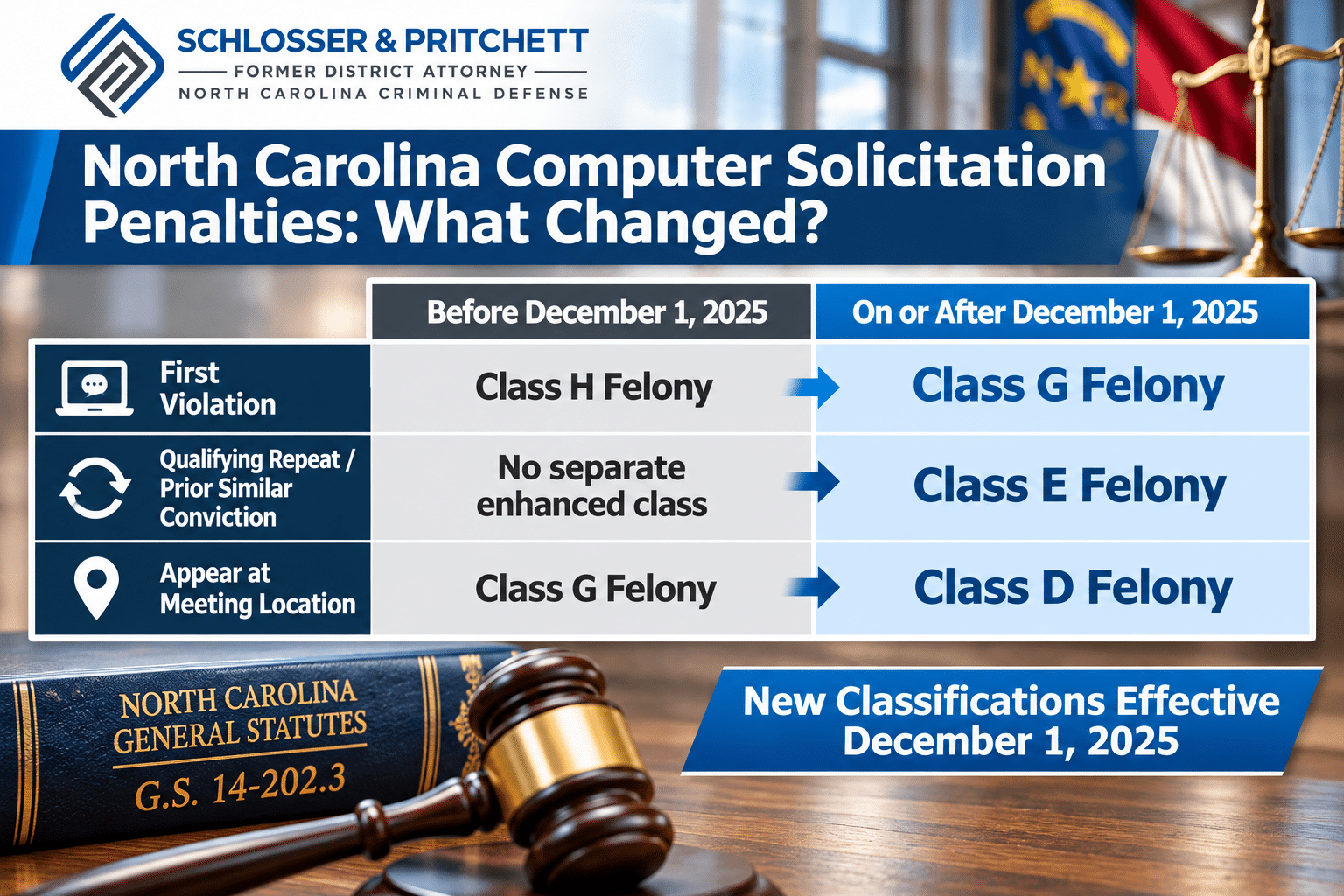
North Carolina’s 2025 Public Safety Act significantly increased the felony penalties for soliciting a child by computer or another electronic device. For offenses committed on or after December 1, 2025, a first violation of G.S. 14-202.3 is now a Class G felony; qualifying repeat offenses can be Class E felonies, and a case can become a Class D felony if the defendant or another person involved in the arrangement actually appears at the planned meeting location.
That means the date of the alleged conduct, the defendant’s prior record, the contents of the electronic communications, and whether anyone actually traveled to or appeared at a meeting location can dramatically affect the potential consequences.
A Greensboro sex crimes lawyer can review the full chat history, device evidence, alleged meeting arrangement, and charging documents to determine which version of North Carolina law applies and whether the State can prove every element of the offense.
What Did North Carolina’s 2025 Public Safety Act Change?
Section 3 of North Carolina’s 2025 Public Safety Act, S.L. 2025-70, amended the punishment provisions of G.S. 14-202.3.
The 2025 solicitation penalty changes created three significant increases:
- First violation: increased from a Class H felony to a Class G felony.
- Second or subsequent violation: now punishable as a Class E felony.
- First violation with a substantially similar prior conviction: also punishable as a Class E felony.
- Appearing at the meeting location: increased from a Class G felony to a Class D felony.
The changes became effective December 1, 2025, and apply to offenses committed on or after that date.
Why Does the December 1, 2025 Effective Date Matter?
The effective date can be one of the most important issues in a computer-solicitation case.
Conduct that occurred before December 1, 2025, is governed by the earlier penalty structure. Conduct occurring on or after that date is subject to the increased classifications created by the Public Safety Act.
In a case involving an extended online conversation, investigators may have messages spanning days, weeks, or longer. That makes it important to identify exactly when the conduct alleged to satisfy the criminal offense occurred rather than simply looking at the date of arrest.
Relevant digital evidence may include:
- Text-message timestamps
- Social media direct messages
- Chat application records
- Email records
- Account login information
- Phone extraction data
- Location information
- Messages discussing a proposed meeting
A careful timeline can help determine which penalty structure applies.
What Does North Carolina Law Prohibit?
The North Carolina computer solicitation law applies to a person who is at least 16 years old and who knowingly, with the intent to commit an unlawful sex act, uses a computer or another device capable of electronic data storage or transmission to entice, advise, coerce, order, or command a qualifying person to meet for that purpose.
The statute can apply when the communication is directed to:
- An actual child under 16 who is at least five years younger than the defendant
- A person the defendant believes is a child under 16 and at least five years younger
- A person the defendant believes is the parent, guardian, or caretaker of such a child
That language is why the offense can arise from undercover investigations in which no actual child is communicating with the accused.
Can an Undercover Officer Pose as a Minor?
Yes. The statute expressly covers communications with someone the defendant believes to be a qualifying child.
As a result, an undercover law-enforcement officer can pose online as a minor, and an actual minor does not necessarily have to participate in the communication for a charge to be filed.
The important questions can instead include what the defendant believed, what was actually communicated, and whether the State can prove the required intent to commit an unlawful sex act.
What Intent Must Prosecutors Prove?
The offense is not based solely on inappropriate, offensive, or sexual communication.
The State must prove that the accused acted knowingly and with the intent to commit an unlawful sex act and engaged in the type of solicitation conduct described by the statute.
That can make the entire conversation important.
Individual messages may look different when read alongside:
- Earlier parts of the conversation
- Later clarifying statements
- Messages from the other participant
- References to age
- Discussions about the proposed meeting
- Statements about the purpose of the meeting
A defense should not necessarily be built around only the screenshots or selected messages quoted in a warrant or police report.
Does the Other Person Have to Be an Actual Child?
No.
North Carolina law also covers situations in which the defendant allegedly believes the person is a child meeting the statutory age requirements.
The statute additionally covers communications with someone the defendant allegedly believes is a child’s parent, guardian, or caretaker when the communication is aimed at arranging the prohibited meeting.
That makes the defendant’s alleged knowledge and belief central to many undercover sting cases.
Does Consent Matter in a North Carolina Computer Solicitation Case?
No. G.S. 14-202.3 expressly states that consent is not a defense to the charge.
That means a defense generally cannot rest on an argument that the person on the other end of the conversation appeared willing to participate.
The more important issues are whether the statutory elements are satisfied, including age or believed age, intent, identity, the nature of the communication, and any alleged meeting arrangement.
What Happens If Someone Actually Goes to the Meeting Location?
This is where the 2025 law creates the most serious increase in punishment.
If the defendant actually appears at the meeting location, the offense is punishable as a Class D felony.
The same Class D classification can apply if another person for whom the defendant allegedly arranged the meeting actually appears at the location.
That makes the details surrounding the supposed meeting especially important.
Potential factual questions include:
- Was a specific meeting location actually agreed upon?
- Was a specific time established?
- Did the accused actually arrive at that location?
- Was the accused traveling somewhere else?
- Who was physically present?
- What device or account was used to arrange the meeting?
- Do location records support the State’s version of events?
How Much More Serious Is a Class D Felony?
The change from the old Class G meeting-location penalty to a Class D felony is significant under North Carolina’s structured sentencing system.
For example, for a defendant at Prior Record Level I, the current presumptive minimum ranges include:
- Class H: 5 to 6 months
- Class G: 10 to 13 months
- Class E: 20 to 25 months
- Class D: 51 to 64 months
The actual sentence depends on the person’s prior record level, whether the court finds mitigating or aggravating factors, and other sentencing rules.
A Class D felony requires active punishment under the current sentencing grid, while lower felony classes can allow different dispositions depending on the defendant’s prior record level.
How Can a Prior Conviction Increase the Charge?
The new law also creates greater exposure for repeat conduct.
A second or subsequent violation of G.S. 14-202.3 is now a Class E felony.
A first violation can also be treated as a Class E felony if the defendant has a prior conviction in a state or federal court that is substantially similar to the North Carolina offense.
That makes the nature and classification of any alleged prior conviction important.
The prosecution may need to establish not only that the prior conviction exists, but also that an out-of-state or federal offense qualifies as substantially similar under the statute.
Can North Carolina Prosecute Messages Sent From Another State?
Possibly.
G.S. 14-202.3 provides that the offense is considered committed in North Carolina for jurisdictional purposes if the transmission either originates in North Carolina or is received in North Carolina.
That means cases can raise jurisdictional issues even when one participant is physically located outside the state.
Does a Computer Solicitation Conviction Require Sex Offender Registration?
Yes. G.S. 14-202.3 is included in North Carolina’s statutory definition of a sexually violent offense for sex-offender registration purposes.
A qualifying conviction therefore carries consequences beyond the felony sentence itself.
Registration obligations can involve:
- Registering with the county sheriff
- Keeping address information current
- Recurring verification requirements
- Reporting certain changes
- Other ongoing compliance obligations
For many registrants, the standard registration period is at least 30 years unless the person later qualifies for and successfully obtains termination under North Carolina law.
Learn more about what happens after sex offender registration in North Carolina.
What Evidence Matters in an Online Sting Case?
Computer-solicitation cases can be heavily dependent on digital evidence.
The prosecution may rely on:
- Complete chat logs
- Selected screenshots
- Phone extractions
- Social media or dating-app records
- Subscriber information
- Search warrants
- Location data
- Undercover recordings
- Statements made after arrest
The defense may need to determine whether the material presented by police is complete and whether the State can connect a particular device, account, or message to the accused.
What Defenses May Be Raised in a Greensboro Computer Solicitation Case?
The available defenses depend on the evidence, but these cases often involve disputes over intent, identity, belief, digital evidence, and police conduct.
Lack of Criminal Intent
The prosecution must prove the specific intent required by G.S. 14-202.3. Ambiguous messages, jokes, fantasy conversations, or statements taken out of context may require closer examination of the full communication history.
Identity or Device Access
Investigators may associate an account or phone with a particular person, but that does not always resolve who actually sent each communication.
Shared devices, shared passwords, multiple account logins, and other access issues can matter.
Belief About Age
In an undercover investigation, the State may rely on what the accused allegedly believed about the other person’s age. The full conversation can matter when determining what was represented and what the accused actually understood.
Whether a Meeting Was Actually Arranged
Because appearing at the meeting location can dramatically increase the felony classification, the defense may closely examine whether there was a definite meeting agreement and whether the evidence proves the accused actually appeared at that location.
Search and Seizure Issues
Phone searches, account records, stored communications, and other digital evidence can raise Fourth Amendment and warrant issues.
A defense attorney can review how law enforcement obtained the device and account evidence and whether a motion to suppress may be appropriate.
Entrapment
Entrapment can be raised in some undercover cases, but the presence of an undercover officer does not, by itself, establish an entrapment defense.
The facts of the interaction matter, including how the conversation began, what conduct the officer encouraged, and whether the evidence supports the legal requirements for the defense.
Can Computer Solicitation Be Charged Alongside Other Sex Crimes?
Yes.
A computer-solicitation investigation can lead to additional allegations depending on the communications, images, meeting circumstances, and other evidence investigators obtain.
Potential related charges can include indecent liberties, sexual offenses, exploitation or child pornography offenses, and other sex-crime allegations.
Learn more about the firm’s representation of clients facing sex crimes charges in Greensboro and Guilford County.
Frequently Asked Questions About North Carolina Computer Solicitation Charges
What is the penalty for a first computer solicitation offense in North Carolina?
For an offense committed on or after December 1, 2025, a first violation of G.S. 14-202.3 is generally a Class G felony unless another provision of the statute requires a higher classification.
What happens if the accused goes to the meeting location?
If the defendant, or another person for whom the defendant allegedly arranged the meeting, actually appears at the meeting location, the offense is punishable as a Class D felony.
Can someone be charged if the person online was actually an undercover officer?
Yes. The statute applies when the defendant allegedly believes the person is a qualifying child, even if the person is actually an undercover officer.
Do the higher penalties apply to conduct before December 1, 2025?
No. The penalty increases created by Section 3 of the 2025 Public Safety Act apply to offenses committed on or after December 1, 2025.
Does a conviction require North Carolina sex offender registration?
G.S. 14-202.3 is classified as a sexually violent offense under North Carolina’s sex-offender registration statutes, so a qualifying conviction is a reportable conviction requiring registration.
Talk to a Greensboro Sex Crimes Lawyer About a Computer Solicitation Charge
A charge under G.S. 14-202.3 can now carry substantially greater felony exposure than it did before December 1, 2025. The difference between a Class G, Class E, and Class D allegation can depend on facts such as prior convictions, the alleged meeting arrangement, and whether anyone actually appeared at the location.
Digital evidence can be equally important. Full chat logs, timestamps, device records, account information, warrants, and location data may all affect how the case should be evaluated.
Jan Pritchett is a former Guilford County Assistant District Attorney and a Board Certified Specialist in State and Federal Criminal Law. He represents clients facing serious felony and sex-crime allegations in Greensboro and throughout North Carolina.
Schedule a free case review with Schlosser & Pritchett if you have been charged with computer solicitation or are under investigation for an online sex offense.
Schlosser & Pritchett
426 W Friendly Ave
Greensboro, NC 27401
Phone: (336) 292-4076