




A shoplifting accusation in North Carolina does not always stay a misdemeanor. Depending on the property’s value, how the accusation is charged, prior theft history, and specific facts, a store incident can become a felony case with consequences that extend far beyond the court.
For someone accused in Greensboro, Guilford County, or elsewhere in North Carolina, the first question is often simple: is this a misdemeanor concealment, a misdemeanor larceny, or a felony larceny? The answer matters because the difference can affect criminal penalties, employment, housing, professional licensing, and a person’s long-term record.
At Schlosser & Pritchett, our Greensboro criminal defense attorneys help clients understand what they are actually facing after an allegation of shoplifting, concealment, larceny, or organized retail theft. The charge listed at the beginning of a case is not always the charge that should stand after the facts and law are reviewed.
Concealment and Larceny Are Two Different Charges in North Carolina
People often use the word “shoplifting” to describe any accusation involving store merchandise. North Carolina law is more specific. Concealment and larceny are separate offenses, and the distinction can matter.
Concealment generally involves hiding or concealing store merchandise while still on the store’s premises without having paid for it. The accusation may involve merchandise allegedly placed in a pocket, purse, bag, cart, stroller, or another location before checkout.
Larceny goes further. A larceny allegation usually involves taking and carrying away property with the intent to permanently deprive the owner of it. In a retail setting, prosecutors may argue that larceny occurred when merchandise was taken past the point of sale, removed from the store, or otherwise carried away with the required intent.
A single store incident can sometimes lead to one charge or multiple charges. Prosecutors may start with a more serious version of the case and allow the facts to be sorted out later. That is why it is important not to assume the initial accusation tells the whole story.
When Shoplifting Is Usually a Misdemeanor
Many first-time retail theft cases begin as misdemeanors. A first concealment offense is generally punished as a lower-level misdemeanor. Misdemeanor larceny may also apply when the property value is $1,000 or less, and no separate felony circumstance applies.
Even a misdemeanor theft-related conviction can create problems. Employers, landlords, schools, licensing boards, and background-check companies may view theft allegations differently from other misdemeanor charges because they can raise questions about honesty or trustworthiness.
That does not mean every misdemeanor shoplifting case has to end in a conviction. Depending on the facts, prior record, evidence, store witnesses, video, and local court practices, a defense lawyer may be able to challenge the charge, negotiate a reduction, pursue a dismissal pathway, or protect eligibility for future record relief.
When Shoplifting Becomes Felony Larceny in North Carolina
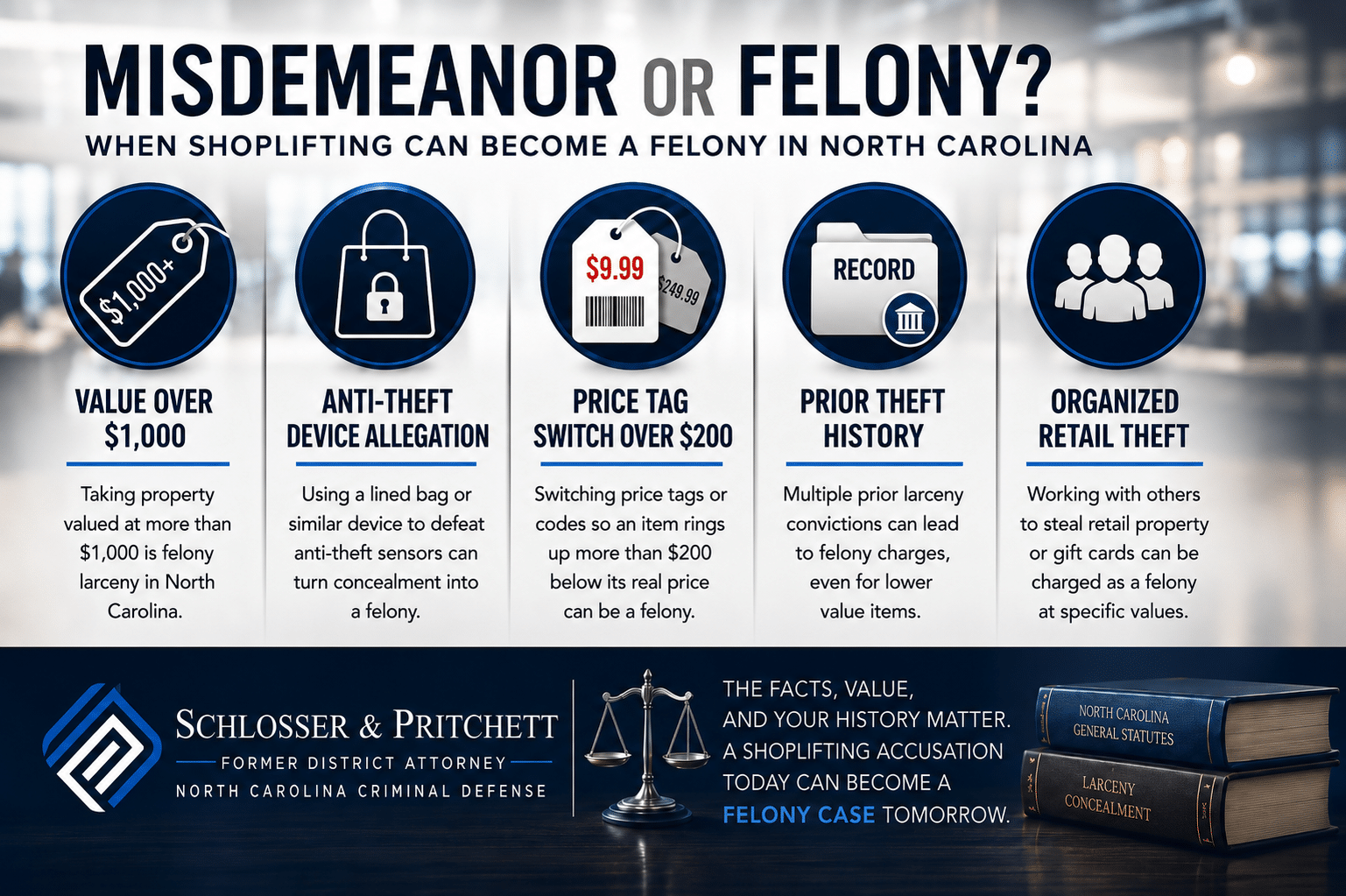
Shoplifting can cross into felony territory in several ways. The most common trigger is the property’s value. In North Carolina, larceny of property worth more than $1,000 is generally charged as a Class H felony.
There are also circumstances in which larceny may be treated as a felony regardless of the property’s value. Examples may include:
- Property allegedly taken directly from another person
- Theft connected to breaking or entering
- Theft of a firearm
- Possession or receipt of stolen goods under felony circumstances
- A prior record that allows the state to pursue felony treatment
North Carolina does not typically use the phrase “grand larceny” in the same way some other states do. Instead, the charge is usually analyzed as misdemeanor or felony larceny based on value, prior history, and the specific circumstances set forth in state law.
When Concealment Can Become a Felony
Concealment is often a misdemeanor, but there are important exceptions. North Carolina law treats certain retail-theft conduct much more seriously.
For example, a concealment allegation can become a Class H felony if prosecutors claim the person used a lead-lined bag, aluminum-lined bag, lined clothing, or a similar device to defeat an anti-shoplifting or inventory-control device.
Price-tag switching can also become a felony in specific circumstances. If a person is accused of transferring or substituting a price tag or product code so that merchandise rings up more than $200 below its actual selling price, prosecutors may pursue a Class H felony charge.
These details matter. A case that sounds like simple “shoplifting” may involve allegations about value, anti-theft devices, price tags, store surveillance, prior convictions, or organized conduct. Each fact can affect how the charge is classified.
What Recent North Carolina Retail Theft Law Changes Mean
Recent North Carolina retail theft discussions have focused heavily on organized retail theft and gift-card schemes. These changes are aimed more at coordinated theft activity, resale operations, gift-card fraud, and repeat or organized conduct than at every first-time shopper accused of hiding an item.
Organized retail theft is different from a basic concealment or misdemeanor larceny case. It generally involves working with others to steal retail merchandise, gift cards, or gift card redemption information for monetary gain. Under North Carolina organized retail theft law, the value of the property or gift cards may be aggregated over a 90-day period, and higher values can increase the felony classification.
In plain terms, the newer retail-theft focus does not mean every shoplifting stop automatically becomes a felony. The felony question still depends on the facts, the value, the person’s prior record, and whether prosecutors can prove one of the circumstances that elevates the charge.
Why the Misdemeanor or Felony Line Matters
The difference between a misdemeanor and a felony can affect far more than the immediate court sentence. A felony theft conviction can create long-term problems involving employment, housing, firearm rights, immigration concerns for non-citizens, professional licensing, and future background checks.
The felony label can also change how prosecutors approach the case. A person facing felony larceny, organized retail theft, or felony concealment may have different court procedures, different sentencing exposure, and a greater need to challenge the evidence early.
The defense may need to examine:
- The value assigned to the merchandise
- Whether the person actually concealed or carried away the property
- Whether the required intent can be proven
- Whether store video supports or contradicts the accusation
- Whether a price-tag or anti-theft-device allegation is accurate
- Whether prior convictions are being counted correctly
- Whether the facts support organized retail theft or only a lesser charge
If you want to understand how prosecutors may evaluate charging decisions more broadly, see our related article on how North Carolina prosecutors decide whether to pursue criminal charges.
Frequently Asked Questions About Shoplifting and Felony Larceny in North Carolina
Is shoplifting always a felony in North Carolina?
No. Many shoplifting-related cases are misdemeanors, especially first-time concealment cases or larceny cases involving property valued at $1,000 or less. Shoplifting may become a felony when the value is higher, certain aggravating facts apply, or the person has a qualifying prior record.
What is the difference between concealment and larceny?
Concealment generally involves hiding unpaid merchandise while still on store premises. Larceny usually involves taking and carrying away property with the intent to permanently deprive the owner of it. A single retail incident may be charged one way or both ways depending on the facts.
When does shoplifting become felony larceny in North Carolina?
Shoplifting may become felony larceny when the property value exceeds $1,000 or when another felony circumstance applies, such as certain thefts from a person, theft tied to breaking or entering, firearm theft, or a qualifying prior theft history.
Can price-tag switching become a felony?
Yes. In North Carolina, certain price-tag or product-code switching allegations can become a Class H felony when the price difference exceeds $200, and the facts meet the statutory requirements.

Talk to a Greensboro Shoplifting Lawyer
If you were accused of shoplifting, concealment, felony larceny, or organized retail theft in Greensboro, Guilford County, or elsewhere in North Carolina, do not assume the case is minor and do not assume the charge is final. The misdemeanor-or-felony line may depend on facts that should be reviewed before you go to court.
Before speaking with store representatives, law enforcement, or prosecutors, take these steps:
- Save any citation, warrant, summons, or paperwork you received.
- Write down what happened while the details are still fresh.
- Do not contact store witnesses or try to explain the incident on your own.
- Speak with a Greensboro criminal defense lawyer about the charge and possible outcomes.
Schlosser & Pritchett represents clients facing shoplifting, concealment, larceny, felony theft, and related criminal charges in Greensboro, Guilford County, and throughout North Carolina. The firm is located at 426 W Friendly Ave, Greensboro, NC 27401.
Call (336) 292-4076, email jpritchettlaw@gmail.com, or contact Schlosser & Pritchett online to discuss your case with a Greensboro shoplifting lawyer.