




Chain of custody errors can become important in a North Carolina drug case because the State must be able to connect the substance tested in the lab to the substance allegedly seized by law enforcement. A missing signature, unclear storage entry, mislabeled envelope, or unexplained transfer may not automatically make the evidence disappear, but it can give the defense a concrete reason to question the reliability of the State’s proof.
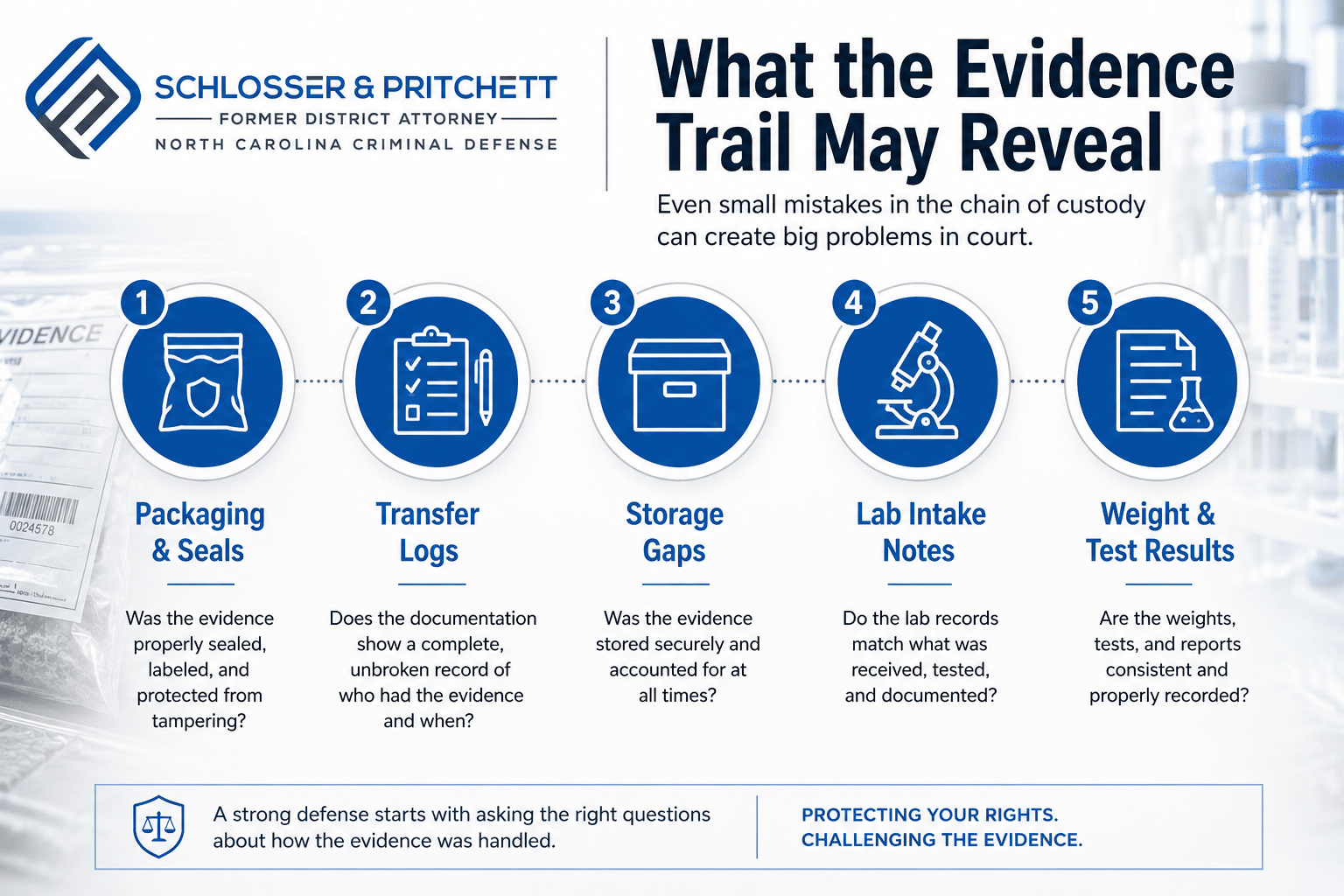
For someone facing drug charges in Greensboro, Guilford County, or elsewhere in North Carolina, the evidence trail matters. The issue is not only what the lab report says. It is also how the substance was collected, packaged, stored, transferred, tested, and presented in court.
At Schlosser & Pritchett, our Greensboro drug crime lawyers review the custody record, lab paperwork, discovery, search issues, and notice deadlines to determine whether the State’s drug evidence can be challenged.
What Chain of Custody Means in a North Carolina Drug Case
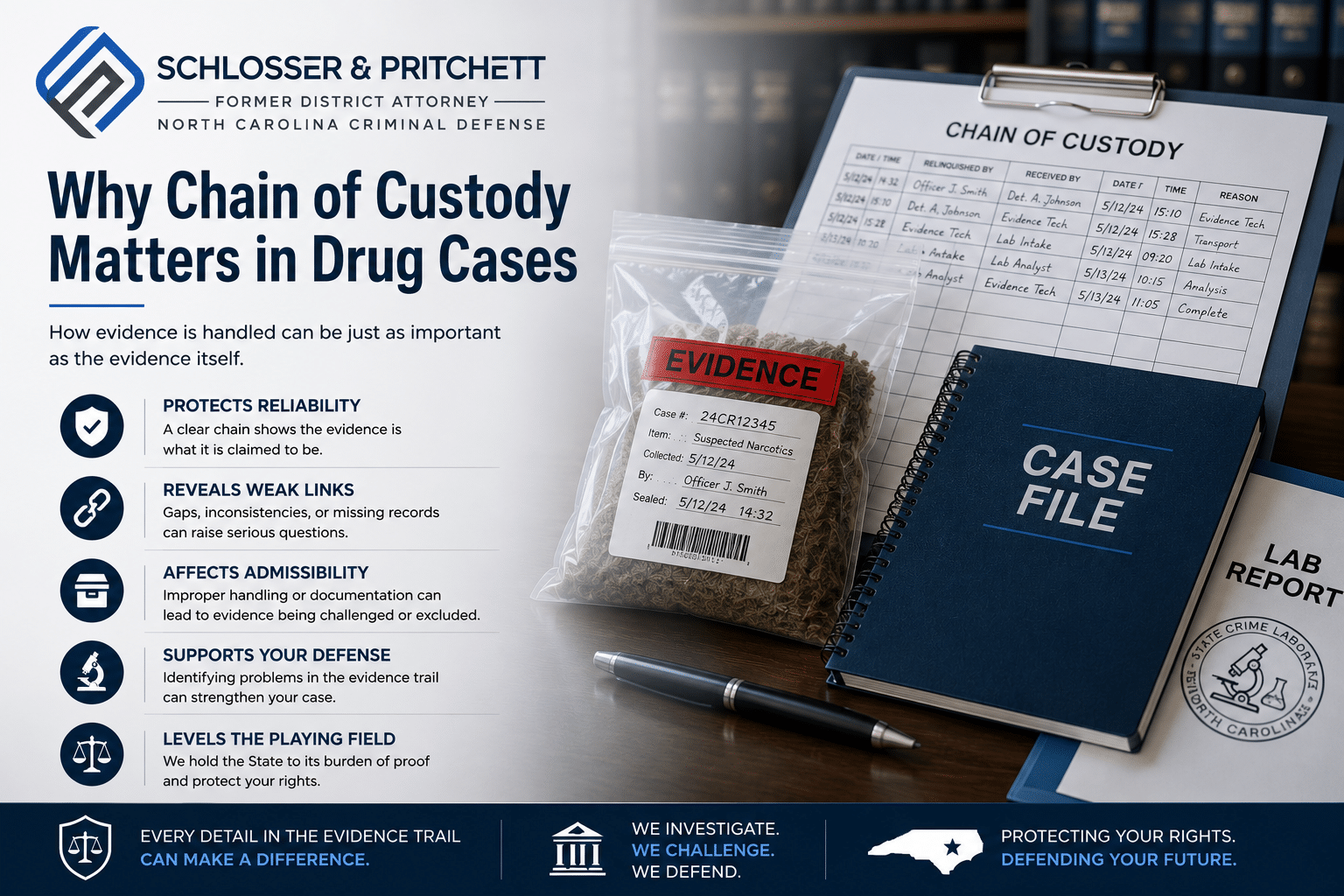
Chain of custody is the documented history of physical evidence. In a drug case, it usually tracks a seized substance from the moment an officer collects it through storage, transfer, laboratory testing, and presentation in court.
A proper chain of custody may include:
- Who seized the substance
- How it was packaged, sealed, and labeled
- Where it was stored before testing
- Who transferred it to the lab
- Who received it, opened it, weighed it, and tested it
- Whether the final lab report matches the item originally seized
North Carolina’s evidence rules do not require perfection before evidence can be admitted. The authentication standard generally asks whether enough evidence supports a finding that the item is what the party offering it claims it is. But meeting that basic admissibility standard is not the same as proving that every handling step was reliable, complete, and beyond challenge.
Do Chain of Custody Errors Automatically Exclude Drug Evidence?
Usually, no. In many North Carolina criminal cases, chain-of-custody problems affect the weight of the evidence rather than whether the jury or judge can hear it at all. In plain English, that means a gap in the custody record may become an argument about reliability instead of an automatic reason for dismissal.
That distinction matters. A defense lawyer may argue that the handling record is incomplete, inconsistent, or unreliable. The prosecutor may respond that the problem is minor and that the evidence is still what the State claims it is. The court then decides whether the issue is serious enough to keep the evidence out or whether the defense can use the problem to attack the State’s case.
That is why chain-of-custody issues should be reviewed carefully, but realistically. A paperwork mistake may not end a case by itself. However, when combined with other problems such as a questionable search, inconsistent police reports, conflicting weights, or unclear lab procedures, it can become part of a much stronger defense strategy.
Why Drug Evidence Handling Matters So Much
Drug charges often depend on laboratory evidence. The State may need to prove what the substance is, how much of it there is, and whether the tested substance matches the item allegedly found during the arrest or search.
Lab findings can affect several types of charges, including:
- Possession charges, where the identity of the substance may determine the offense
- Possession with intent to sell or deliver charges, where the amount and surrounding facts may be important
- Drug paraphernalia charges, where residue or testing may play a role
- Drug trafficking charges, where weight can determine whether a trafficking threshold applies
In trafficking cases, the measured weight can be especially important because North Carolina law sets trafficking penalties based on controlled substance type and quantity. If the record contains inconsistent weights, unclear packaging notes, or unexplained handling gaps, the defense may have a reason to examine whether the State can prove the correct amount beyond a reasonable doubt.
Common Chain of Custody Problems in Drug Cases
Every case is different, but several types of custody issues may deserve close attention. A Greensboro drug crime lawyer may look for problems such as:
- Missing signatures on transfer logs or evidence forms
- Unclear storage entries showing where the substance was kept
- Mislabeled evidence bags or envelopes
- Broken or undocumented seals
- Conflicting dates or times in police reports, lab records, or property logs
- Unexplained changes in weight between seizure, storage, and testing
- Multiple items packaged together in a way that creates confusion
- Unclear lab intake or analyst notes
- Gaps between the seizure date and testing date without adequate explanation
Some of these issues may be minor. Others may raise serious questions about whether the tested substance is the same item allegedly seized from the defendant. The defense must review the actual paperwork and discovery before deciding how much the issue matters.
Lab Reports, Notice Deadlines, and the Right to Question the Analyst
North Carolina procedures can allow certain drug lab reports and chain-of-custody statements to be admitted without live testimony if the State follows the statutory requirements and the defense does not object in time.
This is one of the most important practical issues in a drug evidence case. A lab report may seem like just another document in discovery, but it can affect whether the State has to bring the analyst to court. If the defense misses the objection deadline, the report may come in without the analyst appearing for cross-examination.
A timely objection can preserve the defense’s ability to question the chemist or analyst about the testing process, the substance, the weight, the lab procedures, and any issues in the custody record. That does not mean the State cannot prove its case. It means the defense may be able to require the State to prove the evidence through live testimony rather than paperwork alone.
What a Defense Lawyer May Ask the Lab Analyst
When the analyst or another witness is available for questioning, the defense may focus on how the evidence was handled and tested. Important questions may include:
- When did the lab receive the substance?
- Was the package sealed when it arrived?
- Who opened the package?
- Was the substance weighed before or after packaging was removed?
- What testing method was used?
- Were the instruments calibrated?
- Were there any discrepancies between the police description and the lab intake record?
- Did the analyst rely on any information from law enforcement before testing?
- Did the final report match the original evidence submission?
The goal is not to ask technical questions for their own sake. The goal is to determine whether the State’s evidence is reliable enough to support the charge as filed.
Chain of Custody Issues Often Work With Other Drug Charge Defenses
A custody challenge rarely stands alone. In many cases, it works alongside other defenses. For example, the defense may also examine whether the traffic stop was lawful, whether the search was constitutional, whether officers had probable cause, whether statements were obtained properly, and whether the evidence supports the specific charge.
Drug evidence may be challenged from several angles, including:
- The stop or detention
- The search of a vehicle, home, person, or bag
- The connection between the defendant and the substance
- The identity of the substance
- The weight of the substance
- The handling and testing record
- The State’s compliance with lab report notice rules
If the search was unlawful, the defense may seek to suppress the evidence. If the search was lawful but the custody record is weak, the defense may focus on reliability. If both issues exist, they may become part of a broader strategy to challenge the prosecution’s case.
For a broader look at how evidence issues can affect charging decisions, see our related article on how North Carolina prosecutors decide whether to pursue criminal charges.
Why Early Review Matters in Greensboro Drug Cases
Timing can matter in drug evidence cases. Lab reports, custody statements, discovery deadlines, and objection deadlines can move quietly as the case develops. Waiting too long may limit the defense’s ability to challenge how the evidence reaches court.
An early review can help determine:
- Whether the State has produced the lab report
- Whether the chain of custody statement is complete
- Whether an objection deadline is approaching
- Whether the evidence trail contains gaps or inconsistencies
- Whether the drug weight or identity supports the charge
- Whether a motion to suppress should be considered
In Guilford County and surrounding North Carolina courts, the sooner a defense lawyer can review the evidence trail, the sooner the defense can decide whether to challenge the lab report, question the analyst, negotiate from a stronger position, or prepare for trial.
Frequently Asked Questions About Chain of Custody in North Carolina Drug Cases
What is chain of custody in a drug case?
Chain of custody is the documented record showing how drug evidence was collected, packaged, stored, transferred, tested, and presented in court. It is meant to show that the substance tested by the lab is the same substance allegedly seized by law enforcement.
Can chain of custody errors get drug evidence thrown out?
Sometimes, but not automatically. Many chain of custody problems go to the weight or reliability of the evidence rather than admissibility. Serious gaps, contradictions, or handling problems may support a stronger challenge, especially when combined with other legal issues.
Why does chain of custody matter in drug trafficking cases?
Drug trafficking charges often depend on the type and weight of the substance. If the chain of custody record contains inconsistent weights, unclear packaging notes, or unexplained transfers, the defense may question whether the State can prove the required amount.
Can the defense require the drug lab analyst to testify?
In some situations, yes. North Carolina has notice and demand procedures for certain lab reports and chain of custody statements. A timely written objection may preserve the defense’s ability to require live testimony and cross-examine the analyst.
Talk to a Greensboro Drug Crime Lawyer About the Evidence Trail
If you are facing a drug charge in Greensboro, Guilford County, or elsewhere in North Carolina, do not assume the lab report tells the whole story. The evidence trail behind that report may matter just as much as the result printed on the page.
Schlosser & Pritchett represents clients facing drug possession, trafficking, paraphernalia, and other criminal charges in North Carolina. The firm is located at 426 W Friendly Ave, Greensboro, NC 27401.
Call (336) 292-4076, email jpritchettlaw@gmail.com, or contact Schlosser & Pritchett online to speak with a Greensboro drug crime lawyer about the evidence in your case.