





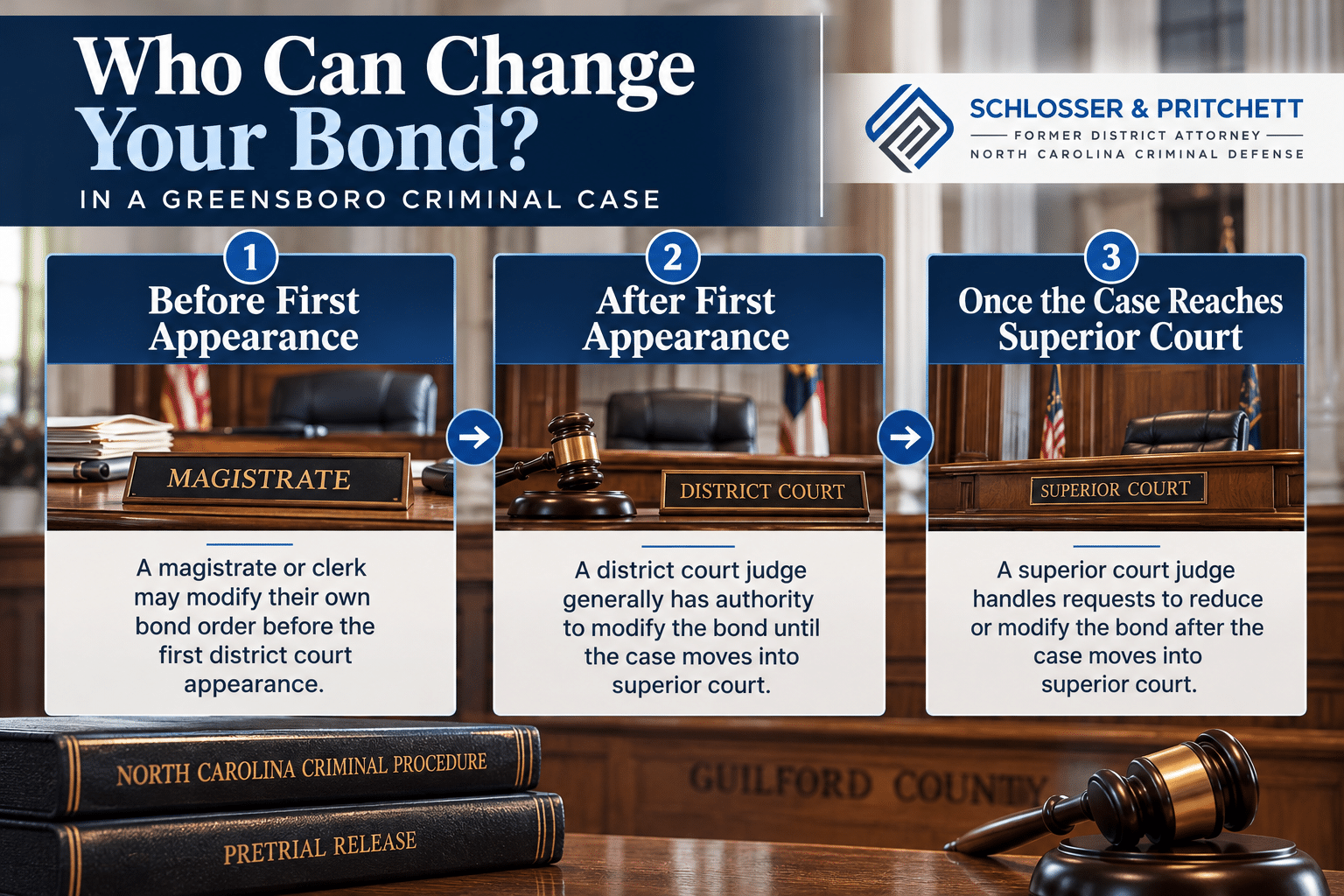
You can generally ask to have a bond or other pretrial release conditions changed before trial in a Greensboro criminal case, but the court that can modify the order depends on where the case is in the process. Before the first district court appearance, a magistrate or clerk may modify an order that person entered. After the first appearance, a district court judge generally has authority until the case moves into superior court. Once the case is before superior court, a superior court judge handles the request.
Special rules apply to some charges, including domestic violence offenses, impaired driving cases, violent offenses, and new charges allegedly committed while someone is already on pretrial release.
A Greensboro criminal defense lawyer at Schlosser & Pritchett can review the release order, identify which court currently has authority, and determine what evidence may support a request for less restrictive conditions.
How Is Bond Set After an Arrest in Greensboro?
North Carolina’s pretrial release law currently provides four primary release options:
- An unsecured appearance bond
- Release into the custody of a designated person or organization that agrees to supervise the defendant
- A secured appearance bond backed by cash, property, or a qualifying surety
- House arrest with electronic monitoring, which must also include a secured appearance bond
The statute removed release on a written promise to appear effective December 1, 2025.
For most defendants who are not charged with a violent offense, the judicial official generally must use an unsecured bond or supervised release unless the official determines that those conditions will not reasonably assure the defendant’s appearance, would pose a danger of injury to another person, or would create a risk of evidence destruction, perjury, or witness intimidation.
If the court makes that determination, it may instead impose a secured bond or house arrest with electronic monitoring and must make the required written findings.
For more background on the initial release decision, see what happens at a North Carolina bail hearing after a felony arrest. This article focuses on what happens when the original bond or release conditions need to be changed.
When Can You Ask a Guilford County Judge to Lower Bond?
The first appearance is often the earliest practical opportunity to ask a Guilford County judge to modify a bond originally set by a magistrate.
Under North Carolina’s first-appearance statute, a defendant who remains in custody generally must appear before a district court judge within 72 hours of being taken into custody or at the county’s first regular session of district court, whichever comes first. If the courthouse is closed for transactions for longer than 72 hours, the statute allows up to 96 hours.
At or after that first appearance, a district court judge can generally modify a pretrial release order entered by a magistrate or clerk while the case remains within the district court’s authority.
That can include:
- Reducing the amount of a secured bond
- Changing a secured bond to a less restrictive form of release when the law permits
- Adding or modifying supervision conditions
- Changing travel, residence, contact, or monitoring restrictions
When Does a Bond Reduction Motion Go to Guilford County Superior Court?
Once a felony case is before superior court, a superior court judge generally has authority to modify pretrial release conditions previously imposed by a magistrate, clerk, district court judge, or another superior court judge.
A defendant who remains in the Guilford County Jail can ask the court to reduce or modify the existing conditions.
Guilford County maintains a Bond Motion Request form through its local court rules and forms page. The current local bond-motion form states that bond motions require at least 48 hours’ notice.
This local procedure matters because a bond motion is not simply an informal request to the judge. Defense counsel should identify the existing bond, the requested amount or conditions, the pending charges, and the information supporting the proposed change.
What Do North Carolina Judges Consider When Deciding Whether to Reduce Bond?
North Carolina law directs judicial officials to consider several personal and case-specific factors when setting or modifying pretrial release conditions.
Those factors include:
- The nature and circumstances of the charge
- The weight of the evidence against the defendant
- Family ties
- Employment
- Financial resources
- Character
- Housing situation
- Mental condition
- Length of residence in the community
- Criminal history
- Any history of flight or failure to appear for court
- Other reliable evidence relevant to pretrial release
A strong bond-reduction request does more than argue that the amount is unaffordable. It addresses the concerns the judge must consider.
What Evidence Can Help Support a Bond Reduction?
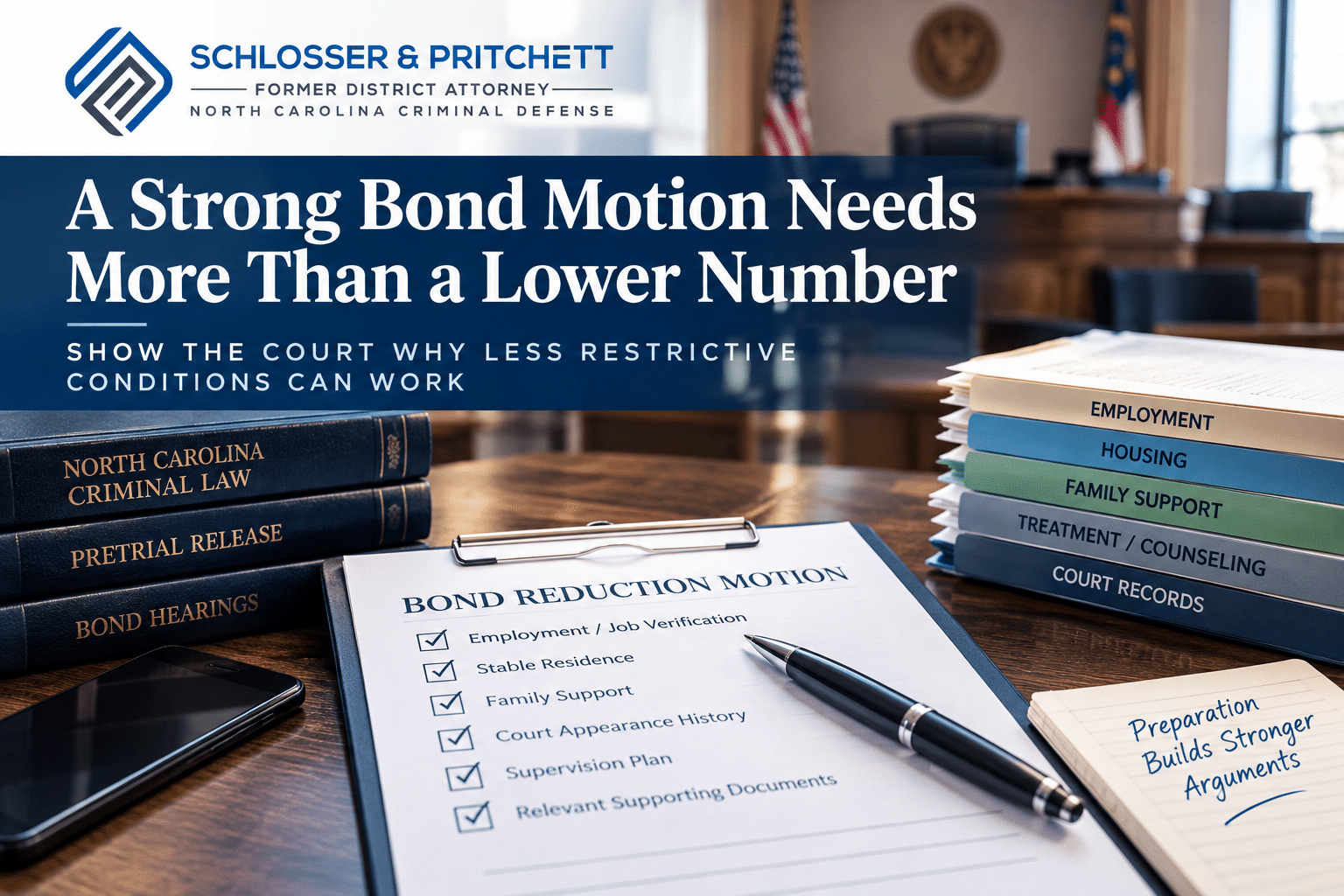
Depending on the case, defense counsel may present documentation showing the defendant has stable ties to Greensboro, Guilford County, or another North Carolina community.
Potentially useful information can include:
- Proof of employment or a job waiting after release
- A stable residence
- Family members willing to provide transportation or supervision
- Evidence of financial circumstances
- A history of appearing for prior court dates
- Treatment or counseling arrangements
- A proposed plan for electronic monitoring or other supervision
- Evidence addressing the specific safety concern raised by the State
The goal is to give the judge concrete reasons to believe that less restrictive conditions can still protect the court process and the community.
Does Being Unable to Afford the Bond Automatically Mean It Will Be Reduced?
No. The fact that someone cannot afford a secured bond is relevant to the practical effect of the order, but it does not automatically require a judge to lower the amount.
The court will still consider the statutory release factors, the nature of the charge, criminal history, prior failures to appear, public-safety concerns, and any special bond rules that apply.
That is why you should approach a bond-reduction hearing as an evidentiary and strategic hearing rather than simply a request for a lower number.
Which Greensboro Charges Have Stricter Bond Rules?
Several categories of North Carolina cases are subject to additional pretrial release rules.
Domestic Violence Charges
For certain domestic violence charges, North Carolina law requires a judge to determine the conditions of pretrial release.
If a judge has not acted within 48 hours after arrest, a magistrate may then set the conditions. A judge may also impose restrictions involving contact with the alleged victim, locations, property, alcohol use, and other conditions authorized by law.
DWI and Other Impaired Driving Charges
An impaired-driving defendant can be detained when a judicial official finds by clear and convincing evidence that the person’s impairment presents a danger of physical injury or property damage if released.
The judicial official still determines the appropriate pretrial release conditions, but the defendant may be held until the impairment no longer creates the statutory danger or a sober, responsible adult assumes responsibility. That detention may not exceed 24 hours under the impaired-driver detention statute.
New Charges While Already on Pretrial Release
If a person is arrested for a new offense allegedly committed while already on pretrial release for another pending case, a judge generally determines the release conditions for the new charge.
The defendant may be held for up to 48 hours while awaiting that judicial determination. If no judge acts within that period, the statute allows a magistrate to set the conditions. Certain Chapter 20 traffic offenses are treated differently.
Violent Offenses
North Carolina now creates a rebuttable presumption that no condition of release will reasonably assure both the defendant’s appearance and community safety when the defendant is charged with a statutory violent offense.
If release is nevertheless granted for a first violent offense, the judicial official must impose a secured bond or house arrest with electronic monitoring.
For certain repeat violent-offense situations, house arrest with electronic monitoring must be imposed if it is available.
Three or More Recent Convictions
A defendant convicted of three or more offenses in separate court sessions within the previous 10 years, each classified as at least a Class 1 misdemeanor, is also subject to more restrictive release rules.
In that situation, the judicial official must generally impose either a secured bond or house arrest with electronic monitoring.
Can Missing Court Make a Future Bond Higher?
Yes.
When a defendant has previously failed to appear on the same charges, North Carolina law can require more restrictive conditions.
If an order for arrest does not recommend specific conditions, the statute generally requires a secured bond of at least twice the most recent secured or unsecured bond for those charges, or at least $1,000 if no bond had previously been required.
That is one reason a missed court date can have consequences beyond simply getting another court date.
Bond can also increase substantially when a person faces multiple serious charges. One example previously discussed by the firm involved a $1 million bond in a North Carolina shoplifting case that also included an attempted murder allegation.
Can a Judge Change the Type of Bond, Not Just the Amount?
Yes, when North Carolina law allows it.
A bond-reduction motion doesn’t have to ask only for a lower dollar amount. Depending on the charge and applicable statutes, the defense may request a different form of release or different conditions.
For example, counsel may argue for:
- An unsecured bond instead of a secured bond
- Release to an approved supervising person or organization
- A lower secured bond
- Electronic monitoring or other structured conditions
- Specific travel, residence, treatment, or contact conditions
Some defendants, however, are statutorily limited to secured bond or house arrest because of the charge, criminal history, or other circumstances.
What Happens If a Bond Reduction Request Is Denied?
A denied request does not necessarily mean the existing conditions can never change.
As the case progresses, authority over pretrial release can shift from the magistrate or clerk to district court and later to superior court. New information, changed circumstances, or additional evidence may also affect a later request.
Whether another motion is appropriate depends on the case’s procedural posture and why the earlier request was denied.
Frequently Asked Questions About Bond Reduction in Greensboro
Can you ask for a bond reduction at your first court appearance?
Yes. If you remain in custody, your first district court appearance is often the earliest practical opportunity to ask a judge to modify conditions initially set by a magistrate or clerk.
How quickly does a first appearance happen in North Carolina?
A defendant who remains in custody generally must appear before a district court judge within 72 hours of being taken into custody or at the first regular district court session, whichever comes first. A 96-hour rule can apply when the courthouse is closed for transactions for longer than 72 hours.
What does a judge consider when deciding whether to lower bond?
The judge may consider the charge, strength of the evidence, criminal history, family and community ties, employment, finances, housing, mental condition, prior failures to appear, and other reliable information relevant to release.
Does Guilford County require advance notice for a bond motion?
Yes. Guilford County’s current Bond Motion Request form states that bond motions require at least 48 hours’ notice.
Can a judge change a secured bond to an unsecured bond?
Sometimes. Whether that change is legally available depends on the charge, criminal history, current release status, and any special statutory pretrial-release rules that apply.
Request a Bond Review With a Greensboro Criminal Defense Lawyer
If someone you care about is being held in the Guilford County Jail on a bond they cannot post, the first step is determining which court currently has authority to change the order and what evidence can address the judge’s concerns.
Jan Pritchett served as an Assistant District Attorney in the Guilford County District Attorney’s Office from 1996 to 2000 and is a Board Certified Specialist in State and Federal Criminal Law. His background gives him experience evaluating the same types of release factors, criminal histories, and case facts that can become important during a bond hearing.
Schlosser & Pritchett represents clients facing felony charges, misdemeanors, DWI, domestic violence allegations, probation matters, and other criminal cases in Greensboro and Guilford County.
If bond is too high, release conditions are unworkable, or a family member is still being held, contact Schlosser & Pritchett to discuss next steps.
Schlosser & Pritchett
426 W Friendly Ave
Greensboro, NC 27401
Phone: (336) 292-4076