




In North Carolina, an alleged victim generally cannot make a domestic violence charge disappear simply by asking prosecutors to drop it. Once law enforcement is involved and a criminal charge is filed, the case belongs to the State of North Carolina, not the person who was allegedly harmed.
That distinction is important for anyone facing a domestic violence accusation in Greensboro, Guilford County, or elsewhere in North Carolina. The alleged victim may be a key witness, and their wishes may affect how prosecutors evaluate the case, but the final decision about whether to pursue, reduce, negotiate, or dismiss the charge usually rests with the district attorney’s office.
At Schlosser & Pritchett, we handle domestic violence defense cases throughout Greensboro and the surrounding Piedmont Triad region. Our attorneys understand how stressful and confusing these cases can be for everyone involved, and we focus on providing clients with clear legal guidance and strong courtroom advocacy from the outset.
How North Carolina Domestic Violence Cases Are Prosecuted
In North Carolina, domestic violence offenses are criminal matters prosecuted by the state government. When officers respond to a domestic violence call and believe that an assault, harassment, communicating a threat, or another crime has occurred, an arrest may follow. After that, the district attorney’s office decides how the criminal case will proceed.
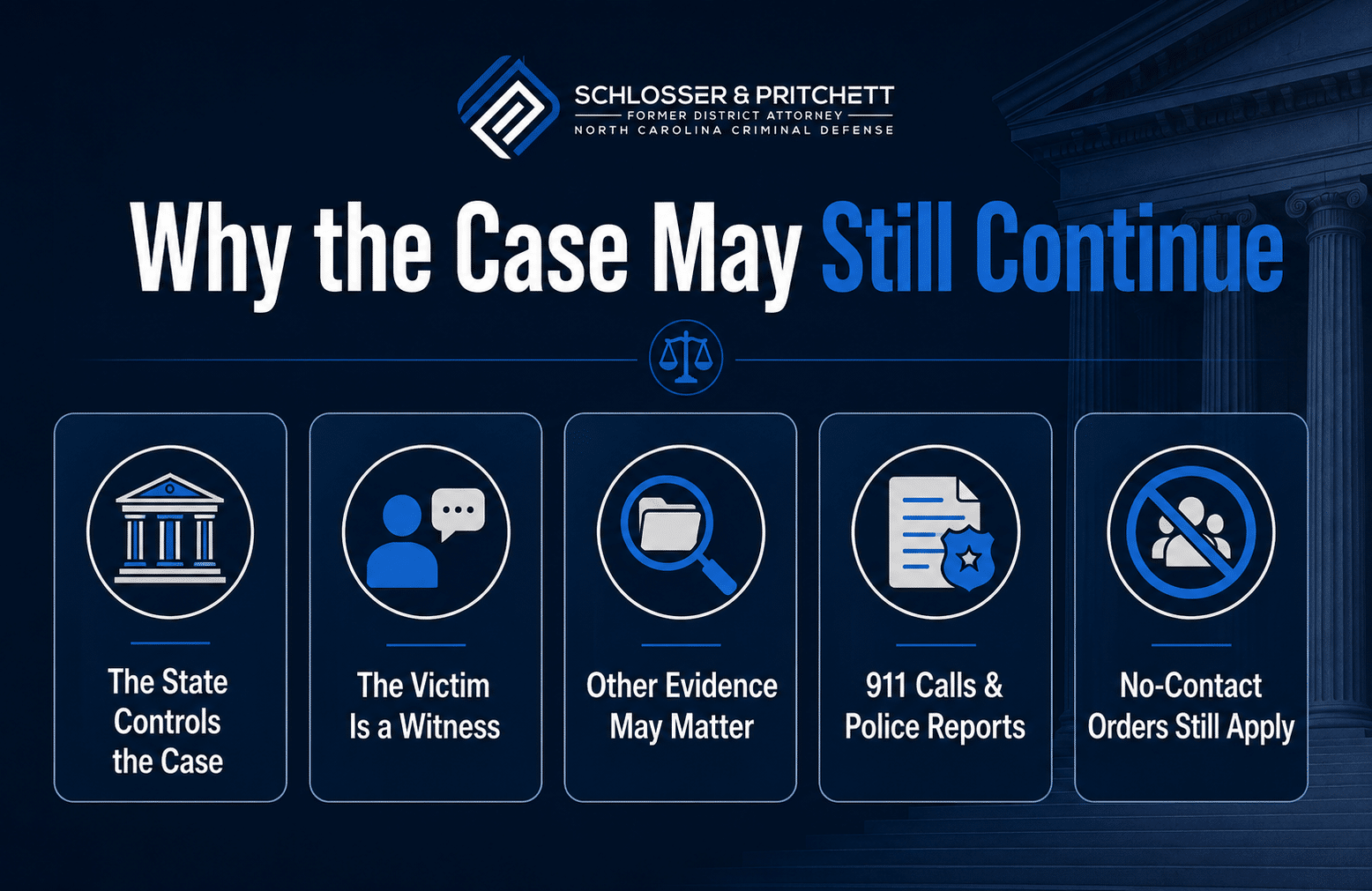
The alleged victim is usually an important witness, but they are not the party bringing the criminal case. The prosecuting party is the State of North Carolina. The North Carolina Judicial Branch explains that in criminal court, the government prosecutes a person for allegedly breaking the law, and the district attorney is responsible for prosecuting criminal cases.
This structure exists because domestic violence situations can be complicated. Prosecutors know that alleged victims may feel pressure to recant, may fear consequences within the household, may depend financially on the accused, may want reconciliation, or may believe the allegations were exaggerated. For that reason, prosecutors do not automatically dismiss a domestic violence case simply because the alleged victim no longer wants the case to move forward.
What Happens When the Victim Wants to Drop Domestic Violence Charges?
When an alleged victim says they want domestic violence charges dropped, prosecutors may consider that information, but they are not bound by it. The district attorney’s office may still decide to proceed if other evidence supports the charge.
That evidence may include:
- Police reports describing what officers saw or heard at the scene
- 911 recordings or emergency call logs
- Photographs of alleged injuries or property damage
- Medical records documenting treatment or injuries
- Witness statements from neighbors, family members, children, or bystanders
- Text messages, voicemails, emails, or social media messages
- Prior incident history or past calls involving the same parties
If the alleged victim refuses to testify or changes their account, the prosecution’s case may become weaker. However, that does not automatically end the case. In some situations, prosecutors may try to rely on other evidence, subpoena the alleged victim, or argue that certain prior statements should be considered by the court.
This is why defendants should not assume the case will go away on its own. A victim’s change of heart can be relevant, but it is only one part of the prosecution’s decision.
Domestic Violence Protective Orders in North Carolina
A domestic violence criminal case is different from a civil protective order case. In North Carolina, alleged victims may seek a Domestic Violence Protective Order under Chapter 50B of the North Carolina General Statutes. These orders are often referred to as 50B orders or DVPOs.
A DVPO can restrict contact between the parties, require one person to leave a shared residence, affect temporary custody arrangements, and create other restrictions. Unlike a criminal charge, a protective order is a civil court matter. The North Carolina Judicial Branch provides public information about how domestic violence protection orders work.
Even if the alleged victim wants contact, a defendant must comply with every term of any protective or no-contact order in place. Violating a DVPO can result in additional criminal charges and make the original case more difficult to resolve.
If a protective order is part of your case, you may also want to review our related article on domestic violence cases and restraining orders in North Carolina.
Can Domestic Violence Charges Actually Be Dismissed?
Yes, domestic violence charges can sometimes be dismissed in North Carolina, but dismissal usually depends on the evidence, the law, and the defense strategy. It does not happen simply because the alleged victim asks for the case to be dropped.
Prosecutors may agree to dismiss or reduce a domestic violence charge if:
- The evidence is insufficient to prove the charge
- The alleged victim’s account is inconsistent or unreliable
- Other witnesses contradict the allegations
- Physical or digital evidence does not support the accusation
- Police reports contain important errors or omissions
- Constitutional issues affect how evidence was obtained
- The facts do not satisfy the legal elements of the alleged offense
Depending on the circumstances, a defendant may also be able to explore deferred prosecution, negotiated resolutions, counseling-related conditions, or other outcomes that may help avoid the harshest consequences. The right approach depends on the specific charge, prior record, evidence, protective order issues, and the policies of the prosecutor handling the case.
A Greensboro criminal defense lawyer can evaluate the evidence, communicate with prosecutors when appropriate, challenge weak allegations, and help protect your rights at each stage of the case.
Why You Should Not Contact the Victim About Dropping the Case
If you are the defendant in a domestic violence case, do not pressure, persuade, or ask the alleged victim to drop the charge. Even if your intentions are peaceful, that kind of contact can create serious legal problems.
If a no-contact order, bond condition, or protective order is in place, contacting the alleged victim may violate a court order. Even without direct threats, prosecutors may view repeated contact as intimidation, coercion, or an attempt to interfere with a witness.
The safer approach is to let your attorney handle the communication strategy. Your lawyer can determine whether contact is legally permitted, whether any court order needs to be modified, and whether information from the alleged victim can be presented in a way that does not create additional risk.

Frequently Asked Questions About Dropping Domestic Violence Charges in North Carolina
Can the victim drop domestic violence charges in North Carolina?
No. Once a domestic violence charge is filed, the case is controlled by the State of North Carolina. The alleged victim may tell prosecutors they do not want to move forward, but the district attorney’s office decides whether to continue, negotiate, reduce, or dismiss the charge.
What if the victim refuses to testify?
If the alleged victim refuses to testify, the prosecution’s case may become weaker, but the case does not automatically disappear. Prosecutors may still try to rely on police reports, 911 calls, photographs, medical records, witness statements, or other evidence.
Can a domestic violence case be dismissed before trial?
Yes. A domestic violence case may be dismissed before trial if prosecutors determine the evidence is insufficient, the witnesses are unreliable, legal issues affect the case, or the facts do not support the charge. A defense attorney can help identify and present those issues.
Can I talk to the alleged victim if they want the case dropped?
You should not contact the alleged victim unless your attorney confirms that contact is legally allowed. Bond conditions, no-contact orders, or Domestic Violence Protective Orders may prohibit contact, even if the alleged victim wants to communicate.
Contact Schlosser & Pritchett in Greensboro
If you are facing a domestic violence charge in Greensboro, Guilford County, or the surrounding North Carolina courts, do not assume the case will resolve itself because the alleged victim wants to move on. The prosecutor may still proceed, and anything you do now can affect the outcome of the case.
Before speaking with law enforcement, contacting the alleged victim, or making decisions about court, take these steps:
- Follow every no-contact order, bond condition, or protective order.
- Save text messages, voicemails, photos, videos, and other evidence.
- Write down what happened while the details are still fresh.
- Speak with a Greensboro domestic violence defense attorney as soon as possible.
Schlosser & Pritchett represents clients facing domestic violence charges and related criminal matters in Greensboro, Guilford County, and throughout North Carolina. The firm is located at 426 W Friendly Ave, Greensboro, NC 27401.
Call (336) 292-4076, email jpritchettlaw@gmail.com, or contact Schlosser & Pritchett online to discuss your case with a Greensboro domestic violence defense lawyer.