





Yes. Text messages can be used as evidence in a North Carolina domestic violence case, but simply showing the court a screenshot is not always enough. The party offering the messages generally must establish that they are authentic, satisfy the hearsay rules when those rules apply, and show that the messages are relevant to an issue in the case.
Texts can become especially important in cases involving protective order violations, stalking, cyberstalking, communicating threats, assault allegations, and disputes over whether prohibited contact occurred.
A Greensboro domestic violence lawyer at Schlosser & Pritchett can review the full message history, determine how the State may try to authenticate the texts, and identify missing context or other issues before the messages are used in court.
How Do Text Messages Become Evidence in a North Carolina Domestic Violence Case?
A text message does not automatically become admissible evidence simply because it appears on someone’s phone.
Several evidence rules can come into play, including:
- Whether the message is relevant to the case
- Whether the message can be authenticated
- Whether the State can establish who sent it
- Whether the message is hearsay
- Whether a hearsay exception applies
- Whether a screenshot or printout accurately reflects the underlying data
- Whether missing portions of the conversation affect the meaning or fairness of the evidence
A message may clear one hurdle and still face a challenge on another.
Texts can be particularly significant because domestic violence in North Carolina does not always require physical injury. Under Chapter 50B, qualifying conduct can include continued harassment that causes substantial emotional distress when the parties have the type of personal relationship covered by the statute.
How Does the State Prove Who Sent a Text Message?
Before a text can be treated as evidence from a particular person, the offering party generally must authenticate it.
North Carolina Rule of Evidence 901 requires enough evidence to support a finding that the item is what the person offering it claims it is.
Authentication can come from several sources.
For example:
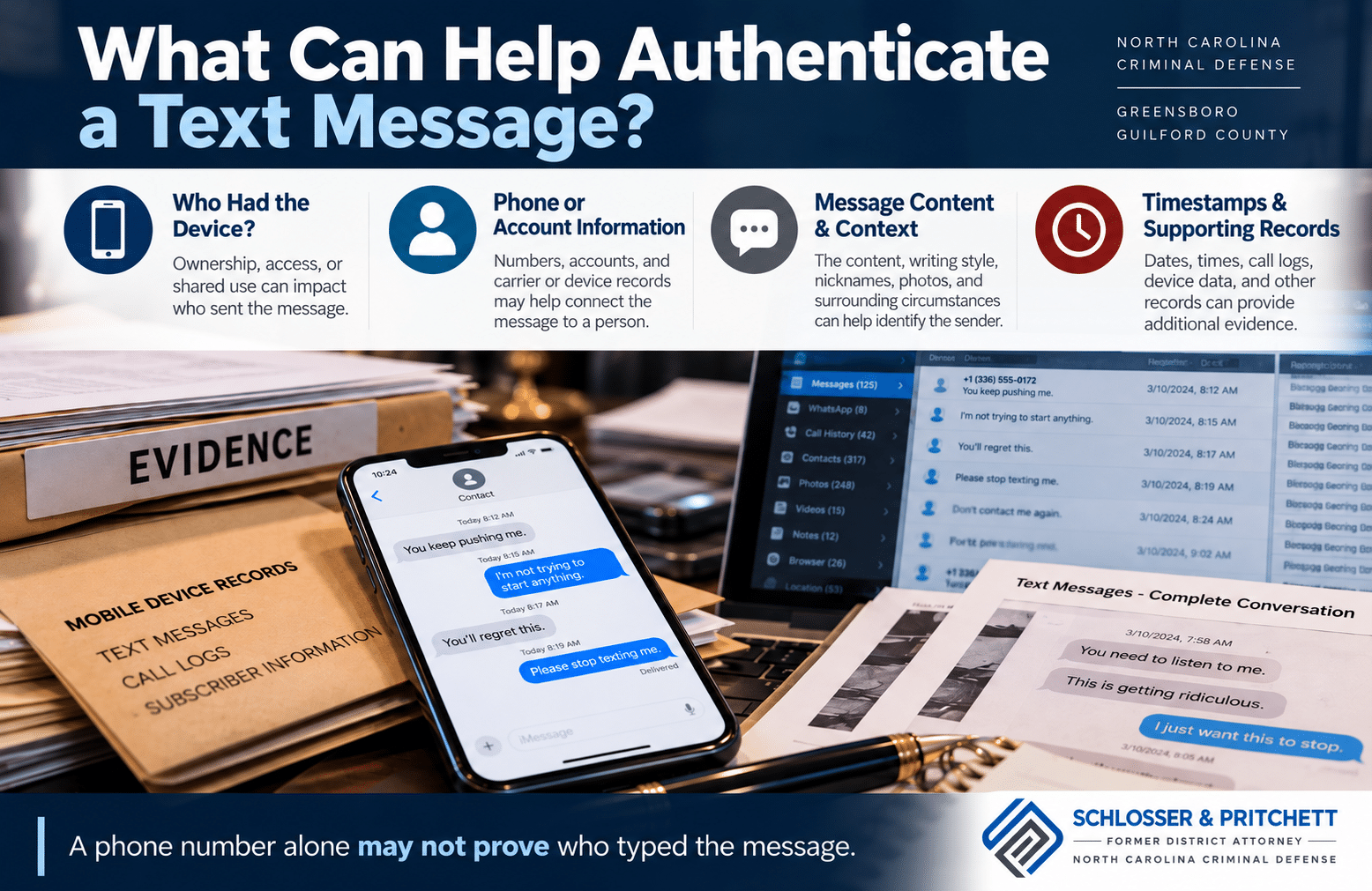
- A witness may testify that they personally received the messages
- The phone number or account may be associated with the alleged sender
- The messages may contain information known only to the alleged sender
- The writing style, nickname, photographs, references, or surrounding circumstances may help identify the sender
- Other phone or account records may connect the communication to a particular device or person
But a phone number by itself does not necessarily prove who physically typed a message.
That distinction matters when the phone was shared, borrowed, left unlocked, used by another family member, or linked to an account accessible from several devices.
Can the Defense Challenge Who Actually Sent the Messages?
Yes.
If authorship is disputed, the defense can examine whether the State has enough evidence to connect the defendant to the communication.
Potential issues include:
- A shared phone or tablet
- Shared social media or messaging accounts
- A recycled or reassigned phone number
- Messages sent from multiple devices
- Missing account information
- No witness who actually saw the defendant send the message
- Incomplete forensic data
The more important the message is to the prosecution’s theory, the more important it can be to separate proof that a message came from an account from proof that a particular person actually authored it.
Are Text Messages Hearsay in North Carolina?
They can be.
North Carolina’s hearsay rules define a statement to include a written assertion. A text offered to prove that what the sender wrote is true may therefore qualify as hearsay unless an evidence rule permits it.
One important rule applies to a defendant’s own texts.
If the prosecution offers a defendant’s own statement against the defendant, North Carolina Rule of Evidence 801 permits that statement as an admission by a party-opponent.
That is why a defendant’s texts can sometimes be used even when a similar statement from another person would face a hearsay objection.
Are All Text Messages Offered for Their Truth?
No.
This distinction is important.
A message may sometimes be offered for a purpose other than proving that the words in the message were factually true.
For example, a text may be offered to show:
- That contact occurred
- That the recipient had notice of something
- The effect the communication had on the recipient
- The context for later conduct
- The existence of a threat or command
- A pattern or course of communication
Whether a particular message is hearsay therefore depends not only on what it says, but also on why the party is offering it.
Can the Alleged Victim’s Text Messages Be Admitted?
Possibly.
If the other person’s text is being offered for the truth of what it says, the court must determine whether a hearsay exception or another rule permits its admission.
Depending on the circumstances, North Carolina’s evidence rules contain exceptions for statements such as:
- A present sense impression describing an event while it is happening or immediately afterward
- An excited utterance relating to a startling event while the speaker remains under the stress of the event
- Certain statements reflecting the person’s then-existing mental, emotional, or physical condition
The facts surrounding the message matter. A text sent during an event can present a different evidentiary question from a message written hours or days later.
Long text threads may also contain multiple statements that must be evaluated separately, rather than treating the entire conversation as automatically admissible.
What North Carolina Domestic Violence Charges Commonly Involve Text Messages?
Text-message evidence can arise in several different criminal cases associated with domestic violence allegations.
Violation of a Domestic Violence Protective Order
A knowing violation of a valid North Carolina domestic violence protective order is generally a Class A1 misdemeanor.
North Carolina law also provides felony consequences in certain circumstances, including some repeat violations and certain violations of stay-away provisions while possessing a deadly weapon.
If a protective order prohibits direct or indirect contact, a text message may become evidence that prohibited contact occurred.
That does not eliminate authentication or other evidence issues. The State still must connect the communication to the accused and prove the required elements of the offense.
Cyberstalking
North Carolina’s cyberstalking statute covers several forms of electronic communication.
The statute includes electronic communications containing certain threats as well as repeated electronic communications made for prohibited purposes such as abusing, threatening, terrifying, harassing, or embarrassing another person.
The statute expressly defines qualifying electronic communications broadly enough to include communications transmitted through cellular phones and other electronic means.
Stalking
North Carolina stalking law can involve a course of conduct that includes electronic communications directed at or concerning another person.
A standard stalking offense is generally a Class A1 misdemeanor. A stalking offense committed while a court order is in effect prohibiting the conduct can be a Class H felony, while a subsequent stalking conviction can carry different felony consequences.
Text threads can matter because they may show a pattern of communication rather than an isolated message.
Communicating Threats
North Carolina communicating-threats law applies when a qualifying threat is communicated orally, in writing, or by another means.
A text message can therefore be the communication at the center of a Class 1 misdemeanor communicating-threats charge.
The message’s wording is only part of the inquiry. The statute also requires that the threat be credible and that the recipient believed it would be carried out.
Assault Cases
Texts may also be used in assault cases even when the alleged assault itself did not occur through electronic communication.
For example, the prosecution or defense may use messages to establish context, chronology, motive, intent, the parties’ relationship, or what happened immediately before or after an alleged confrontation.
An assault on a female by a male who is at least 18 years old is generally a Class A1 misdemeanor in North Carolina.
Learn more about the firm’s representation of clients facing domestic violence charges in Greensboro.
Can Screenshots of Text Messages Be Used as Evidence?
Yes, screenshots and printouts can potentially be used as evidence.
North Carolina Rule of Evidence 1001 provides that when information is stored in a computer or similar device, a readable printout or other output that accurately reflects the stored data can qualify as an original for evidence purposes.
Rule 1003 also generally permits duplicates unless there is a genuine question about authenticity or admitting the duplicate would be unfair under the circumstances.
That means the original phone isn’t physically handed to the judge or jury, but a screenshot can still be admissible.
But the screenshot still has to satisfy the other evidence rules.
Why Can Cropped Screenshots or Partial Conversations Be a Problem?
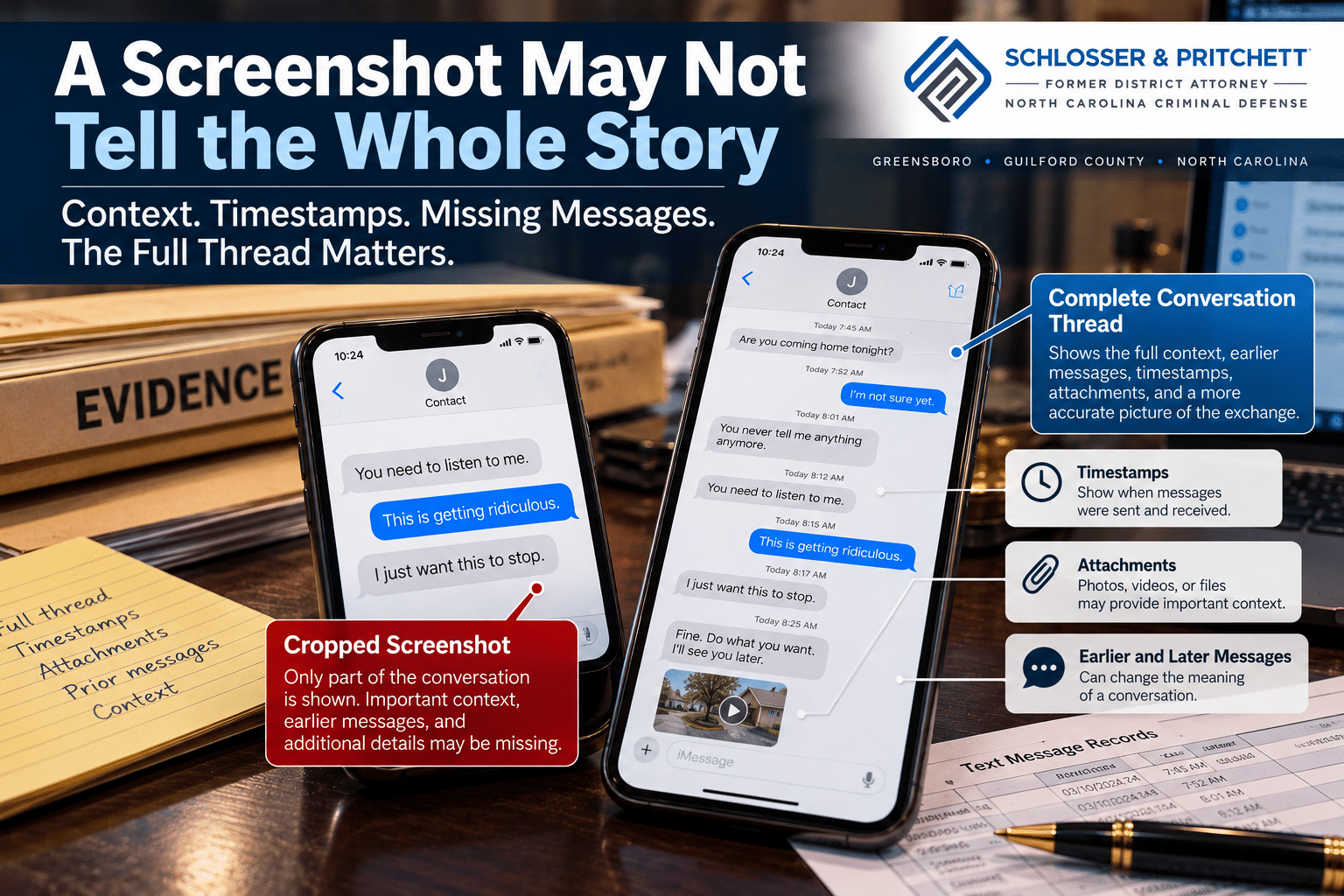
A single screenshot can make a conversation appear very different from the complete thread.
Potential problems include:
- Earlier messages being omitted
- Replies being cut off
- Dates or timestamps being missing
- The sender’s identifying information being cropped out
- Messages from different days being presented together
- Deleted portions changing the apparent context
- Images or attachments not being included
A defense lawyer may compare screenshots with the actual device, exported message history, discovery provided by the State, or other available records.
The goal is not simply to determine whether the words shown in the screenshot exist. It is to determine whether the screenshot accurately and fairly represents the conversation the State claims it represents.
Can Phone Company Records Prove What a Text Message Said?
Not necessarily.
Carrier records may help establish subscriber details, communication logs, timing, or other account data, depending on what records exist and how they are obtained.
But carrier records do not necessarily provide the actual content of ordinary text conversations.
That distinction is one reason the original device, screenshots, cloud backups, application data, and forensic extraction may become important.
The firm has previously discussed the broader role of cell phone records in North Carolina criminal cases.
Can Deleted Messages Still Matter?
Yes.
Deleting a message from one device does not necessarily mean every copy of the communication is gone. The other participant’s phone, synced devices, cloud backups, application data, screenshots, or previously collected forensic evidence may still contain information.
Someone facing a criminal case should not delete, alter, edit, crop, or manufacture message evidence.
Preserving the original phone and the full conversation gives defense counsel a better chance to determine what actually exists and whether the State’s version of the exchange is complete.
Can Text Messages Help the Defense Too?
Absolutely.
Digital evidence is not automatically prosecution evidence.
A complete text conversation may:
- Provide context missing from a screenshot
- Contradict an allegation about when contact occurred
- Show that communication was initiated by someone else
- Clarify the meaning of an allegedly threatening statement
- Show an ongoing conversation rather than unilateral harassment
- Help establish a timeline
- Identify inconsistencies between statements and digital records
Whether those messages are ultimately admissible is a separate legal question, but they can still be important when investigating the accusation and preparing a defense.
What Should You Do If Text Messages Are Part of Your Domestic Violence Case?
If texts, screenshots, social media messages, or other digital communications may be important, preserving the evidence early can matter.
Practical steps may include:
- Do not delete the conversation
- Keep the original phone
- Preserve the complete thread rather than only selected screenshots
- Do not edit or annotate the original evidence
- Keep associated photographs, attachments, and voice messages
- Tell your attorney if another person had access to the device or account
- Follow all no-contact orders and release conditions
Do not send additional messages simply to create evidence or explain your side of the dispute if a court order or bond condition prohibits contact.
If a criminal charge already exists, the alleged victim generally does not control whether the prosecution continues. See our article explaining whether a North Carolina domestic violence charge can be dropped by the victim.
Frequently Asked Questions About Text Message Evidence in North Carolina
Can a screenshot of a text message be used in court in North Carolina?
Yes, potentially. A screenshot or printout may be admissible if it accurately reflects the underlying data and the party offering it can satisfy authentication and other applicable evidence rules.
Does a phone number prove who sent a text?
Not necessarily. A phone number can be part of the authentication evidence, but courts may also consider witness testimony, message content, account information, distinctive characteristics, and surrounding circumstances.
Are a defendant’s own text messages hearsay?
A defendant’s own statements can generally be offered against that defendant under North Carolina’s rule governing admissions by a party-opponent.
Can cropped screenshots be challenged?
Yes. Missing messages, timestamps, sender information, attachments, or other context can raise questions about authenticity, completeness, and whether the screenshot accurately represents the conversation.
Should I delete text messages that could hurt my case?
No. Do not delete, alter, or manufacture evidence. Preserve the original device and messages, and let your attorney review the full conversation and decide how to handle the evidence.
Review the Text Message Evidence With a Greensboro Domestic Violence Lawyer
When a domestic violence case turns on text messages, the most important evidence may be more than the few screenshots included in a police report.
The full thread, original device, timestamps, account information, missing messages, surrounding communications, and the purpose of each statement can all affect how the evidence is analyzed.
Schlosser & Pritchett represents clients facing domestic violence allegations and other criminal charges in Greensboro, Guilford County, and throughout North Carolina. The firm’s attorneys include former prosecutors who understand how both sides of a criminal case may evaluate digital evidence.
If texts or screenshots are being used against you, preserve your phone and the full conversation, and schedule a consultation with Schlosser & Pritchett.
Schlosser & Pritchett
426 W Friendly Ave
Greensboro, NC 27401
Phone: (336) 292-4076