




Yes, prior convictions can sometimes be used against you in a North Carolina criminal case, but the prosecution generally cannot introduce them simply to argue that you committed a new crime because you committed crimes before. Whether a jury can hear about an earlier conviction depends heavily on why the State wants to use it, whether you testify, how old the conviction is, and whether the prior record becomes relevant for another legally permitted purpose.
For someone facing a felony, misdemeanor, drug, assault, theft, DWI, or other criminal charge in Greensboro or Guilford County, this distinction can be critical. A prior record may affect the trial itself, a defendant’s decision about testifying, or the sentence imposed after a conviction.
A Greensboro criminal defense lawyer can examine not only what convictions appear on a defendant’s record, but also how the prosecution is attempting to use them.
Can Prosecutors Use a Prior Conviction Just to Show You Are Guilty?
Generally, no.
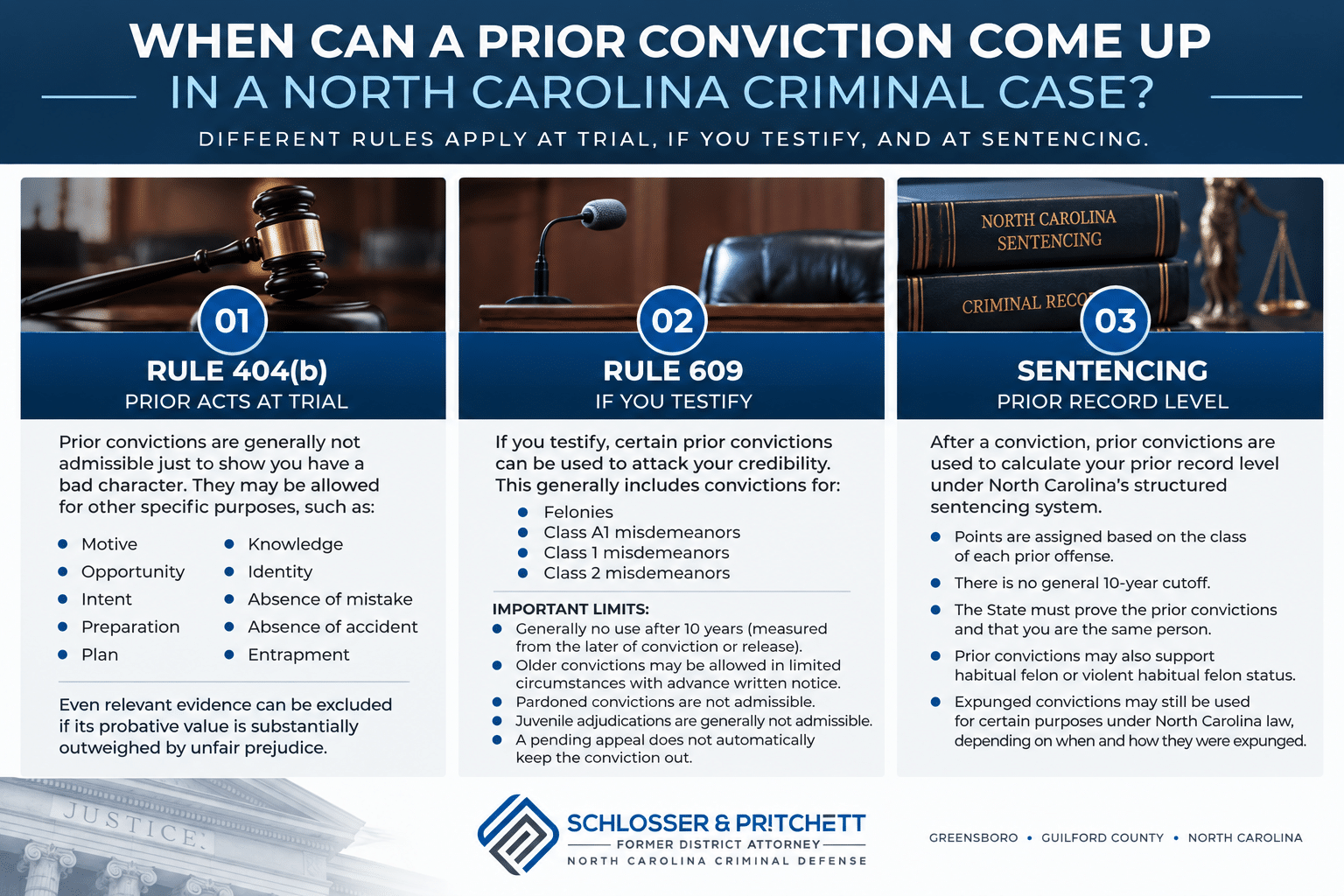
North Carolina Rule of Evidence 404(b) provides that evidence of other crimes, wrongs, or acts is not admissible merely to prove that a person has a certain character and acted consistently with that character.
In practical terms, a prosecutor generally cannot tell a jury:
“This defendant committed a crime before, so he probably committed this one too.”
That kind of propensity argument is exactly what the rule is designed to restrict.
However, Rule 404(b) also allows evidence of prior crimes or acts when offered for another legally relevant purpose, such as:
- Motive
- Opportunity
- Intent
- Preparation
- Plan
- Knowledge
- Identity
- Absence of mistake
- Absence of accident
- Entrapment-related issues
That means the real question is often not simply whether a prior conviction exists. The question is why the State says the jury needs to hear about it.
What Is Rule 404(b) Evidence in North Carolina?
Rule 404(b) deals with evidence of prior crimes, wrongs, or other acts that the prosecution may attempt to connect to an issue in the current case.
For example, prosecutors may argue that an earlier act is relevant to intent, knowledge, identity, or another disputed issue rather than merely to show bad character.
The defense can challenge whether the earlier conduct actually proves the claimed issue or whether its real effect is simply to encourage jurors to judge the defendant based on the past.
Even relevant evidence may be excluded under North Carolina Rule of Evidence 403 when its probative value is substantially outweighed by dangers such as unfair prejudice, confusion of the issues, or misleading the jury.
For that reason, disputes over prior-act evidence often require careful analysis before trial.
Can Prior Convictions Be Used If You Testify in Your Own Defense?
Yes. This is a separate issue from Rule 404(b).
If a defendant chooses to testify, the defendant becomes a witness. North Carolina Rule of Evidence 609 allows certain prior convictions to be used to attack a witness’s credibility.
The rule generally permits impeachment with convictions for:
- A felony
- A Class A1 misdemeanor
- A Class 1 misdemeanor
- A Class 2 misdemeanor
The conviction may be elicited during cross-examination or established through a public record.
This is one reason the decision about whether a defendant should testify at trial can be complicated. The defense must consider not only what the defendant can say about the current charge, but also what prior convictions the prosecution may be able to use once the defendant takes the stand.
Is There a 10-Year Limit on Using Prior Convictions to Impeach a Defendant?
Usually, Rule 609 places significant restrictions on convictions that are more than 10 years old.
The 10-year period is measured from the later of:
- The date of the conviction; or
- The date the witness was released from confinement imposed for that conviction.
That second date matters.
For example, a conviction entered many years ago may still fall within the Rule 609 period if the defendant was released from confinement much later.
A conviction beyond the 10-year period may still be admitted in limited circumstances if the court determines that its probative value, supported by specific facts and circumstances, substantially outweighs its prejudicial effect. The party seeking to use the older conviction must also provide sufficient advance written notice.
What Other Limits Apply to Prior Convictions Under Rule 609?
North Carolina’s Rule 609 includes several other important limitations:
- Pardoned convictions: A conviction that has been pardoned is not admissible under Rule 609.
- Juvenile adjudications: Juvenile adjudications generally cannot be used to impeach the accused under this rule.
- Pending appeals: A conviction under appeal is not automatically inadmissible, although evidence that the appeal is pending may be admitted.
These rules are technical, and small details involving the conviction date, release date, classification of the offense, and procedural history can affect the analysis.
Are Prior Convictions Treated Differently at Sentencing?
Yes. The rules governing what a jury may hear at trial differ from the rules governing sentencing after a conviction.
For North Carolina felony sentencing, the State’s structured sentencing system assigns points to prior convictions. The total qualifying points establish a defendant’s prior record level.
The court then considers that prior record level with the classification of the current felony to determine the applicable sentencing range.
North Carolina currently uses six felony prior record levels:
- Level I: 0-1 point
- Level II: 2-5 points
- Level III: 6-9 points
- Level IV: 10-13 points
- Level V: 14-17 points
- Level VI: 18 or more points
The point value of a prior conviction depends on factors including the classification of the earlier offense.
That means a conviction that may not be admitted before the jury for one evidentiary purpose can still have significant consequences if the defendant is later convicted and sentenced.
Do Old Convictions Still Count at Sentencing?
There is no general Rule 609-style 10-year cutoff for calculating North Carolina felony prior-record points.
However, prior-record calculations can involve additional rules governing which convictions count, how multiple convictions are treated, whether an out-of-state offense is substantially similar to a North Carolina offense, and whether the State has properly proven the record.
For example, North Carolina law provides special rules for multiple convictions obtained during the same superior court calendar week.
The State also has the burden of establishing qualifying prior convictions through one of the methods permitted by law.
For defendants with lengthy records, convictions from other states, or complicated sentencing histories, reviewing the prior-record worksheet can be an important part of the defense.
Does an Expunged Conviction Still Matter in a North Carolina Criminal Case?
Possibly.
Don’t assume an expunged conviction can never be considered again in a criminal proceeding.
Under current North Carolina law, certain convictions expunged on or after July 1, 2018 may still be accessible to prosecutors and may be used for specified criminal-law purposes, including:
- Calculating a prior record level or prior conviction level
- Supporting certain habitual-offense allegations
- Increasing the level of a later offense when a prior conviction is legally relevant
- Certain Rule 404(b) purposes
- Certain Rule 609 impeachment purposes
Whether an expunged matter can affect a new case therefore depends on when and how the expungement occurred and the purpose for which the State seeks to use it.
Learn more about North Carolina expungement and criminal-record issues.
Can Prior Convictions Lead to Habitual Felon Status?
Yes. Prior felony convictions may also expose you to North Carolina’s habitual-felon laws.
Under North Carolina law, a person who has three qualifying prior felony convictions may be charged as a habitual felon when prosecuted for another qualifying felony.
Habitual-felon status is not simply evidence that the jury hears to decide whether the defendant committed the new offense. North Carolina uses a separate statutory process for determining habitual status.
If habitual-felon status is established, the principal felony is generally sentenced four felony classes higher, subject to a maximum sentencing classification of Class C.
The convictions used to establish habitual-felon status are not then counted again when calculating the prior record level for that habitual-felon sentence.
For a fuller explanation, see our guide to North Carolina habitual felon laws and enhanced sentencing.
What Is Violent Habitual Felon Status?
North Carolina also has a separate violent habitual felon statute.
A person with two qualifying prior violent felony convictions may fall within the statute if the required sequence and other statutory conditions are satisfied.
If a person is convicted of a new violent felony and also found to be a violent habitual felon, North Carolina law requires life imprisonment without parole, except where the death penalty is imposed.
The statute also prohibits suspending that sentence or placing the defendant on probation.
Because the consequences are so severe, the dates, classifications, sequence, and validity of the alleged prior convictions must be examined carefully.
Will the Jury Automatically Hear About Habitual Felon Status?
No.
North Carolina’s habitual-felon procedure generally keeps the habitual-felon indictment from the jury while it decides guilt on the underlying felony.
If the jury finds the defendant guilty of the principal felony, the habitual-felon allegation can then be addressed through the separate statutory process.
This separation matters because prior convictions could otherwise create a serious risk that jurors would use the defendant’s record when deciding whether the State proved the new charge.
Why Prior-Conviction Issues Should Be Reviewed Before Trial
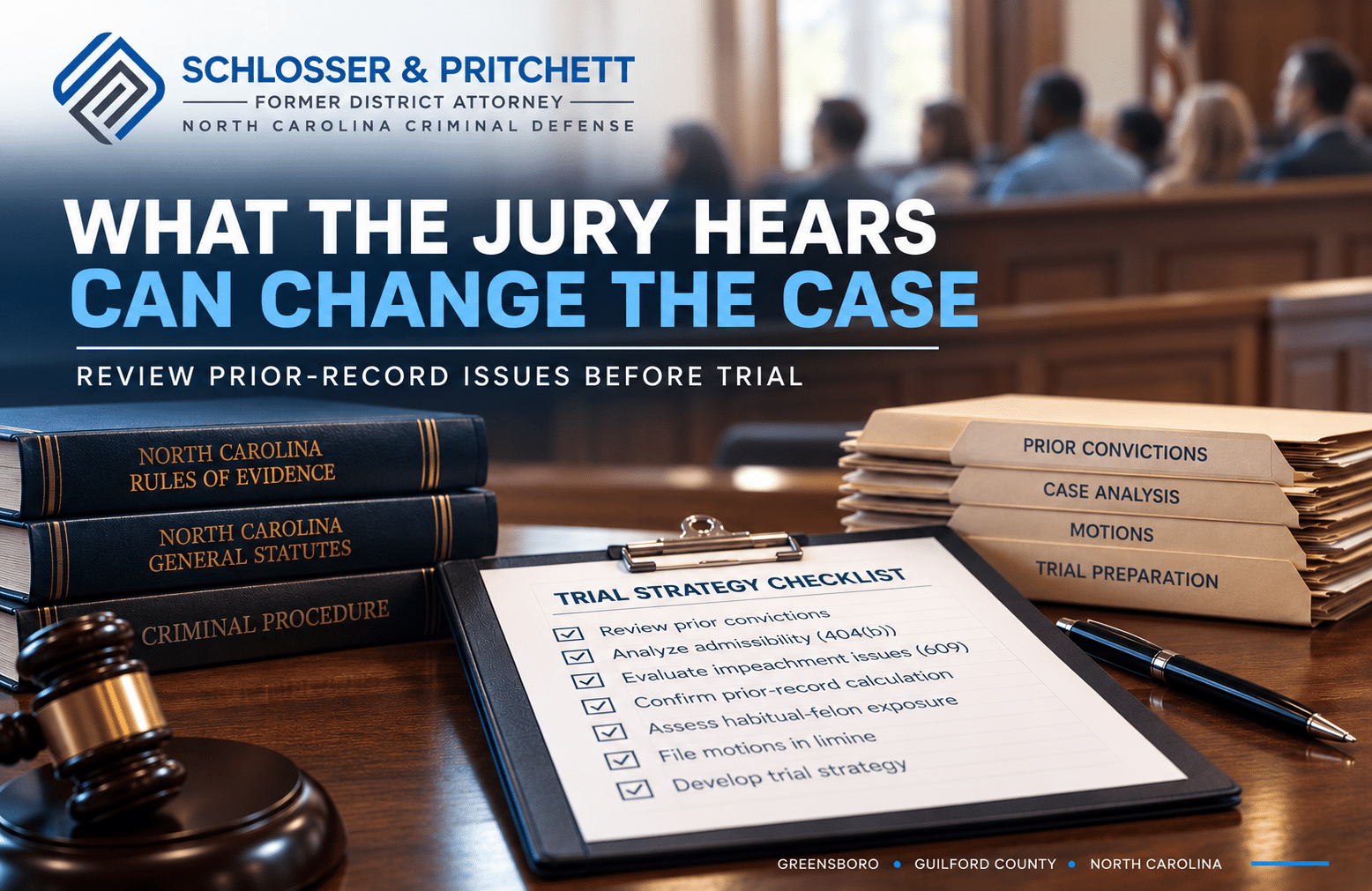
Questions involving prior convictions can affect several major strategic decisions before a North Carolina criminal trial, including:
- Whether the defense should challenge proposed Rule 404(b) evidence
- Whether a motion in limine should be filed before trial
- Whether the defendant should testify
- What convictions may be raised during cross-examination
- Whether the State’s sentencing record is accurate
- Whether habitual-felon allegations are legally supported
- Whether an out-of-state conviction qualifies under North Carolina law
Waiting until the jury has already heard prejudicial information may be too late to undo the damage. Identify and litigate these issues before trial whenever possible.
Frequently Asked Questions About Prior Convictions in North Carolina Criminal Trials
Can the prosecutor tell the jury about all of my prior convictions?
No. A prosecutor generally cannot introduce every prior conviction simply to show that you are a bad person or are more likely to have committed the current offense. Different rules apply depending on the purpose for which the State seeks to introduce the conviction.
Can a prior conviction be used if I testify?
Yes. If you testify, certain felony and misdemeanor convictions may be used to attack your credibility under North Carolina Rule of Evidence 609, subject to the rule’s limitations.
Are convictions more than 10 years old automatically excluded?
No. They are generally subject to stricter limitations under Rule 609, but an older conviction may still be admitted if the required legal standard and notice requirements are satisfied.
Can an old conviction still increase my sentence?
Yes. The 10-year Rule 609 limitation concerns impeachment at trial. North Carolina’s sentencing rules use a different system for calculating qualifying prior convictions.
Can an expunged conviction ever be used again?
Yes, in some circumstances. North Carolina law allows certain convictions expunged on or after July 1, 2018 to be considered for specified criminal-law purposes, including some sentencing, habitual-offense, Rule 404(b), and Rule 609 issues.
Talk to a Greensboro Criminal Defense Lawyer About Your Prior Record Before Trial
If prosecutors have indicated that they intend to use one or more prior convictions in your case, the important questions are which convictions they want to use, why they believe the convictions are admissible, and what can be done before the jury hears them.
Jan Pritchett is a former Guilford County Assistant District Attorney and a Board Certified Specialist in State and Federal Criminal Law. He represents clients facing felony charges, misdemeanors, DWI, drug charges, theft allegations, probation matters, and other criminal cases in Greensboro and throughout North Carolina.
Contact the Law Firm of Schlosser & Pritchett to discuss how a prior record may affect your current case.
Schlosser & Pritchett
426 W Friendly Ave
Greensboro, NC 27401
Phone: (336) 292-4076
Contact Schlosser & Pritchett online